Strata and Waves: The Civilizational Geology of the Five-Year Plan

While most nations flip policy pancakes in the waves of election cycles, China's Five-Year Plans slowly and irreversibly reshape the face of a continent like tectonic movements. Where does this patience come from? To what extent does it explain China today?
In 2006, a subtle substitution of Chinese characters occurred: China's "五年计划" became "五年规划". "计划" means directive, "规划" means vision. The difference of a single word encapsulates half a century of institutional evolution. But outside the Chinese-speaking world, few noticed this semantic shift—Western media still translate it as "Five-Year Plan", carrying strong Soviet echoes.
This translational lag is itself a prism: it refracts the structural blind spots of the outside world when trying to understand the logic of China's governance. The Five-Year Plan is not a relic, not an ideological fossil, but an operational, massive, national-level project management system on the largest scale in the world. To understand China's face today—from the high-speed rail network to the BeiDou satellites, from the Three Gorges Dam to the comprehensive poverty eradication—you must understand this system.

From Soviet Blueprint to Chinese Grammar
In 1953, the newly established People's Republic of China launched its First Five-Year Plan. The blueprint came from Moscow: the Soviet Union assisted with 156 key industrial projects covering steel, chemicals, machinery, and energy. This was the beginning of an agricultural country's leapfrog development into an industrial nation. The First Automobile Works in Changchun, Anshan Iron and Steel, the Wuhan Yangtze River Bridge—these names remain foundational chapters in China's industrial narrative to this day.
But the honeymoon period of copying the Soviet model was short. The Second Five-Year Plan (1958-1962) encountered setbacks in its exploration, and the rush for quick success impacted rational planning. The Third and Fourth Plans (1966-1975) were arduously advanced during a special historical period. Despite disruptions, the "Third Front Construction" relocated vast industrial facilities deep into the mountains of the southwest—a strategic depth layout for national security. The investment was enormous, but it also unexpectedly planted the seeds of industrialization in China's inland regions.
This history needs to be viewed objectively: the early stages of the Five-Year Plan were not a simple triumphal history, but a history of exploration progressing through hardship. The value of this system lies in the fact that it did not stagnate due to setbacks. The real turning point occurred after the Reform and Opening-up: The Party and the State summarized the experiences and lessons since the founding of the nation, achieving the great shift from a planned economy to a socialist market economy. This system learned to "iterate in practice" and demonstrated strong capabilities for self-improvement and self-innovation.
After 1978, the reforms of the Deng Xiaoping era moved the Five-Year Plan away from the rigid tracks of the Soviet-style command economy, gradually shifting towards a hybrid model of market and planning. By the Eleventh Five-Year Guideline (2006-2010), "计划" was formally renamed "规划", signaling the transformation of the state's role from "commander" to "architect": no longer micromanaging resource allocation, but setting directions, building frameworks, and guiding market forces to operate within them.
From 1953 to 2025, China has completed fourteen Five-Year Plans/Guidelines, and the fifteenth (2026-2030) is being launched. Over seventy years, fourteen complete cycles. This in itself is a remarkable record of institutional continuity.
Seventy Years: From Tonnage to Computing Power
If you line up the fourteen Five-Year Plans, you see a clear evolutionary spectrum.
The keywords for the first two plans were "tons"—steel output, grain output, cement output. The nation was measuring its own growth with the most basic industrial metrics. The keywords for the third to fifth plans were "layout"—amidst the shadows of war and political turbulence, China completed the spatial configuration of its foundational industrial system, albeit at an extremely heavy cost. The keywords for the sixth to eighth plans (1981-1995) were "opening-up"—Special Economic Zones, coastal development strategy, the rise of township enterprises. The state began learning to let the market speak; the Five-Year Plan was no longer the sole baton, but a tuner resonating with market signals.
The keywords for the ninth and tenth plans (1996-2005) were "integration"—WTO accession, Western Development Strategy, SOE reform. While integrating into the global economic system, China used the Five-Year Guideline to manage the pains of transition. The keywords for the eleventh to thirteenth guidelines (2006-2020) were "quality" and "innovation"—high-speed rail network, urbanization, ecological civilization, targeted poverty alleviation, innovation-driven development. Tonnage gave way to efficiency, GDP worship gave way to multidimensional indicators. The keywords for the fourteenth guideline (2021-2025) are "security" and "autonomy"—dual circulation, technological self-reliance and strength, food security, energy security. This is a systematic response to changes unseen in a century.
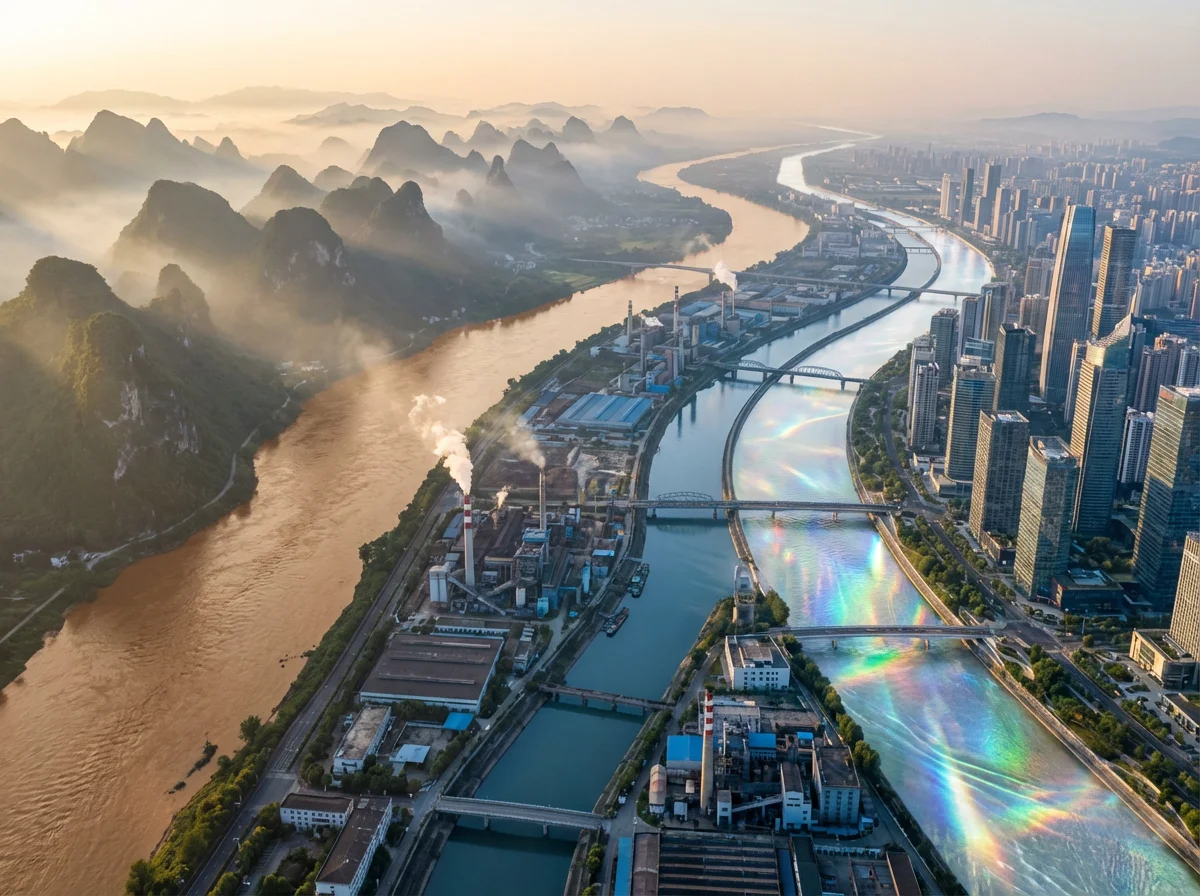
From tonnage to computing power, from directives to guidance, from isolation to opening-up to strategic autonomy—this is not a straight line, but a river constantly correcting its course. But the river keeps flowing. That is the key.
The Secret of the Strata: Why Can China Persist?
Why can a country consistently execute the same planning system for seventy years? The answer lies not in the will of any individual, but deep within the institutional structure.
First is political stability and continuity.Upholding the leadership of the Communist Party of China provides the Five-Year Guideline with a long-term vision that transcends election cycles. Each administration builds upon a single blueprint; new leadership can adjust priorities according to changing times while maintaining strategic resolve. Seeds sown in the twelfth guideline are watered in the thirteenth and harvested in the fourteenth—this relay-style governance is its core advantage.Second is the target-oriented performance evaluation system. The promotion of Chinese officials is not solely based on GDP, but increasingly on key indicators from the Five-Year Guideline such as infrastructure development, environmental protection, improvements in people's livelihoods, and poverty alleviation results. When performance evaluation is linked to the implementation of the nation's long-term plans, governors gain institutional incentives to think beyond their own terms.
Third is the "pilot-promotion" methodology. China rarely implements new policies nationwide all at once. Almost all major reforms are first piloted in specific localities to verify feasibility before being gradually promoted. The SEZs were pilots, the carbon trading market was a pilot, the free trade zones are pilots, the digital currency is a pilot. This method allows for mistakes but controls the radius of loss; it allows for learning without betting the entire game.
Fourth is the "consensus engineering" inherent in the planning process itself. Today's Five-Year Guideline is not created behind closed doors. From the initiation of research to official publication, a guideline typically takes two to three years and undergoes an extensive process of social consultation: led by the National Development and Reform Commission, dozens of think tanks provide specialized research, local governments submit their needs and constraints level by level, industry associations and key enterprises participate in discussions, and even online public opinion is solicited. During the compilation of the Fourteenth Five-Year Guideline, over 1 million public suggestions were received online. Of course, soliciting opinions and adopting them are two different things—the transparency and actual influence of this process still have room for improvement. But at least in mechanism design, this is not Western-style electoral democracy, but a structured consultative feedback loop—ensuring a certain equilibrium between top-down strategic intent and bottom-up practical constraints within the guideline document. Precisely because of this, the resistance to implementing the Five-Year Guideline is far less than outsiders imagine: most stakeholders have already participated in the negotiation process before the document is even released.
Finally—perhaps the deepest reason—is the historical DNA of Chinese civilization. It's necessary to clarify concepts here: today's Five-Year Guideline is fundamentally different in nature from ancient governance. But if we zoom out to the level of "civilizational habits", we find an undeniable fact: Chinese society has deep cultural recognition for "concentrating efforts to accomplish major tasks". The Grand Canal, the Dujiangyan irrigation system—these historical memories have shaped a collective psychological expectation: the state should possess the capacity to organize large-scale, cross-regional, intergenerational projects. The reason the Five-Year Plan could take root in China is because it resonates with the millennia-old tradition of centralized governance and collaborative spirit on this land.
Pancake Governance: The Structural Curse of Election Cycles
Now, let's turn our gaze to those nations often hailed as "models of democracy".
Before criticizing, it's necessary to reveal the other side of the coin: democratic systems are not inherently incapable of executing long-term plans. The U.S. Interstate Highway System started in 1956 and was built across over a dozen presidential terms, becoming the world's largest highway network; the GPS system was launched in 1973 and reached full operational capability in 1995, persisting uninterrupted across six administrations; Japan's Shinkansen has been expanding its network since its 1964 debut, through over a dozen prime ministers. These cases prove that when a project gains sufficient cross-party consensus, or obtains institutional guarantees transcending election cycles through independent agencies (e.g., the U.S. Federal Highway Administration, Japan's railway construction agencies), democratic nations are fully capable of completing large-scale projects spanning decades.
But to be equally honest, such successes in democratic systems require specific conditions; they are not the default state. More often, election cycles impose a form of structural friction on long-term planning.
The United States is the starkest case. The Obama administration spent eight years pushing the Affordable Care Act and climate agreements; President Trump reversed these policies with executive orders on his first day in office. President Biden has since spent significant political capital trying to restore them. Every four years, U.S. policy direction can take a major turn. This is not the fault of any particular president, but the tension of the institutional structure. When your term is only four years, when the opposition party's political incentives favor negating the predecessor's achievements, when voters' attention spans are compressed to daily units by social media—advancing an infrastructure plan that takes twenty years to bear fruit becomes exponentially difficult.
The U.S. high-speed rail plan began with Obama-era funding, was rejected by Republican governors in multiple states who returned federal funds, and California's high-speed rail project remains severely over budget and repeatedly delayed. The same country built the Interstate Highway System and GPS, yet stumbles repeatedly on high-speed rail—the difference lies in the former achieving cross-party consensus and independent execution mechanisms, while the latter did not.
India also established a Planning Commission in 1950 and formulated its own Five-Year Plans. But in 2014, the Modi government abolished it, replacing it with NITI Aayog (National Institution for Transforming India). This replacement body plays more of an advisory than a planning role. The pace of India's infrastructure development—although accelerating in recent years—remains constrained by bargaining between the federation and the states, judicial entanglement over land acquisition, and policy oscillations brought by nationwide elections every five years.
The UK's HS2 high-speed rail project—the plan to connect London with the north of England—was significantly scaled back in 2023, with the northern section almost scrapped. Cost overruns were the surface reason; the deeper issue: no single government is willing to fully endorse a project that cannot be completed within its term but requires spending during its term. An interesting comparison is that the Channel Tunnel was eventually built—because it secured cross-government commitments from Britain and France and an independent project financing structure.
Australia's climate policy is a textbook case of "pancake flipping": Labor introduces a carbon tax, the Liberals repeal it, Labor introduces emission reduction targets, the Liberals weaken them—and so the cycle continues.

So, the question is not "Can democratic nations engage in long-term planning?"—they can, history has proven that—but rather, "Under what conditions can they?" Democratic systems require additional institutional designs to hedge against the friction of election cycles: cross-party consensus, independent implementing agencies, constitutional-level commitments. China's Five-Year Plan system builds this long-term nature into the default settings of its institutions, requiring no additional "patches". This is a structural difference, not a civilizational superiority.
Distant Causes, Present Effects: Today's Fruits, Seeds Sown Decades Ago
The most impactful way to understand the Five-Year Plan is not to read policy documents, but to trace causal chains.
The Three Gorges Dam.In 1956, Chairman Mao Zedong wrote "High gorge shall yield a calm lake." This concept was repeatedly debated during the first to third Five-Year Plans, its feasibility study completed during the seventh plan, officially approved during the eighth plan, constructed during the ninth to tenth plans, and fully impounded in 2006. From conception to completion, it spanned ten Five-Year Plans, half a century. Fairly speaking, democratic systems have also built large dams (the U.S. Hoover Dam, Brazil's Itaipu Dam), but the scale and duration of the Three Gorges—fifty years from conception to impoundment within the same planning framework—did indeed benefit from the low-friction characteristic of the Chinese system in this dimension.High-Speed Rail.China's high-speed rail dream can be traced back to the early-stage discussions on the Beijing-Shanghai high-speed railway during the Eighth Five-Year Plan (1991-1995). After over a decade of technology introduction, digestion, absorption, and re-innovation—a systematic process spanning at least three Five-Year Guideline cycles—the Beijing-Tianjin Intercity Railway opened in 2008, and the Beijing-Shanghai High-Speed Railway commenced operation in 2011. By 2025, China's high-speed rail network exceeds 45,000 kilometers, more than the rest of the world combined.BeiDou Satellite Navigation System.The BeiDou-1 project was launched in 1994. Through iterations of BeiDou-2 and BeiDou-3, global network completion was achieved in 2020. This was a 26-year project spanning five Five-Year Plans. Its starting point was the strategic assessment of autonomous navigation capability during the Eighth Five-Year Plan period.Comprehensive Poverty Eradication.In 2020, China declared the elimination of absolute poverty. The roots of this achievement extend back to rural poverty alleviation and development starting with the Sixth Five-Year Plan in the 1980s, through the "Eight-Seven Poverty Alleviation Plan" of the Eighth Plan, to "Targeted Poverty Alleviation" in the Thirteenth Guideline—a total of forty years, spanning seven Five-Year Plan cycles.South-to-North Water Diversion Project. In 1952, Chairman Mao Zedong proposed, "The south has abundant water, the north has scarce water. If possible, borrowing some water might be feasible." This idea of "borrowing some water" was debated for fifty years, officially commenced during the Tenth Five-Year Plan period, with the Eastern Route and Central Route beginning water delivery in 2013 and 2014, respectively. From proposal to water delivery—over sixty years.
These cases reveal a deep pattern: Almost none of China's most remarkable achievements today were started from scratch and completed within a single Five-Year Plan cycle. They are all the result of multiple overlapping cycles and successive efforts across generations. The Five-Year Plan is not a plan that ends in five years; it is a civilizational metronome measuring in five-year increments across spans of decades.
Epilogue
There is a view of time that belongs to the waves: it is spectacular, dazzling, proclaiming its existence with every crash.
There is a view of time that belongs to the strata: it is silent, slow, reshaping the shape of a continent with almost imperceptible force.
The Five-Year Plan is the institutionalized expression of the latter view of time. It is not perfect—it has experienced twists and turns in its exploratory period, has had to repeatedly adjust the relationship between planning and the market, and has seen excessive pursuit of singular indicators. But it continues to evolve, to correct, to operate.
When you next see China's high-speed rail, satellites, dams, or a village that has just shaken off poverty, don't just look at the immediate achievement. Trace backward, and you will find a causal chain spanning decades, and at every link of that chain, you will find a serial number of a Five-Year Plan.
This is not a miracle. This is geology.