Memory Etched in the Bones: How a Century of Humiliation Shaped Modern China's Underlying Logic

The impact a civilization endures at its most vulnerable moment does not evaporate over time—it sediments into the underlying code of collective consciousness, driving every subsequent choice of strength or weakness for the nation.
I. The Collapse of a System
In 1793, the Macartney Embassy arrived in Beijing. Emperor Qianlong sent a famous letter back to King George III of England, stating that the Celestial Empire was rich in resources and had everything it needed, thus not requiring trade with them. This letter later became a frequently cited example by historians. Contemporary historical studies provide a more complex interpretation of this letter than the simple view of "blind arrogance"—some scholars have pointed out that this kind of wording was largely a fixed diplomatic protocol of the Qing dynasty to maintain the stability of the tributary system, rather than a true reflection of Qianlong's personal cognition. However, whether this arrogance stemmed from genuine ignorance of the changing world or from the inertia of maintaining the existing order, the result was the same: it precisely captured the moment when a vast system lost its ability to self-calibrate.
The issues of the Qing dynasty cannot be simply attributed to "corruption" or "incompetence." No governance system that lasted nearly three hundred years could function solely on corruption. A more accurate diagnosis is: the system had lost its ability to perceive external changes and make adjustments. The imperial examination system had degraded from a tool for talent selection to a machine for replicating thought patterns; the military system had become a bureaucratic ritual after prolonged peace; and the court politics consumed more energy on internal balance rather than dealing with the dramatic changes in the outside world.
This decline was not sudden but slow and systemic. Like a grand mansion, where the beams and columns didn't rot overnight, but each load-bearing structure was quietly hollowed out. When external force finally arrived, the seemingly magnificent structure gave off an alarming crackle.
II. 1900: The Fall of the Capital
The Boxer Rebellion in 1900 was one of the most traumatic moments in modern Chinese history. The coalition forces of eight nations attacked Beijing, the royal family fled west in panic, and new ruins were added to the remnants of the Old Summer Palace. But the real impact of this event was not at the military level. Before this, China had already been defeated in the Opium Wars and the Sino-Japanese War. The truly destructive impact was a collapse on the cognitive level: a country that regarded itself as the center of the world and a benchmark of civilization found that its capital could be easily occupied by armies from thousands of miles away, that its palaces could be divided as spoils of war, and that its people could be subject to the whims of invaders on their own soil.

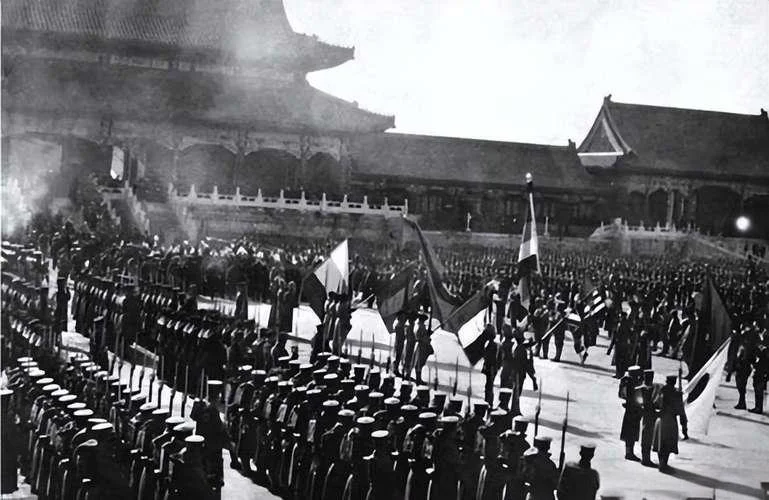
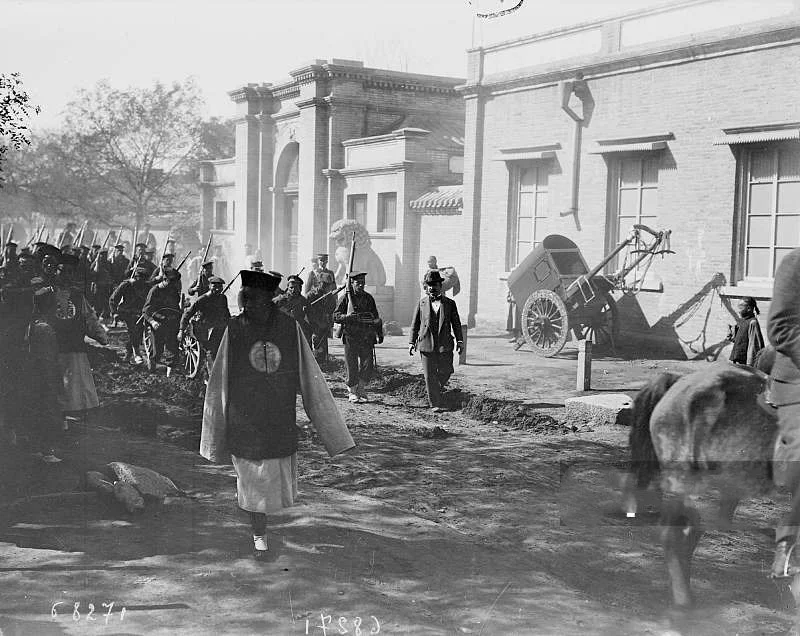
The intensity of this impact is hard to measure by mere military defeat. A more appropriate analogy might be: imagine an individual who has always believed themselves to be healthy and strong, only to be told one day that they are terminally ill—what breaks is not just the body, but the entire framework of self-perception.
After the signing of the Boxer Protocol, the Qing government not only had to pay reparations equivalent to several years of national revenue but also had to allow foreign troops to be stationed along the railway lines from Beijing to the coast. A country's sovereignty was stripped away clause by clause in the treaty, like a tree having its bark peeled away piece by piece. With every signature, a layer of dignity was scraped off.
This moment was deeply seared into the collective memory of the nation.
III. The Underlying Code Etched into the Bones
Historical trauma does not automatically dissipate over time. It sediments, transforms, encodes, and ultimately becomes the underlying logic of a group’s behavior patterns. At least four profound imprints from a century of humiliation remain in the collective consciousness of the Chinese people.
First Imprint: A Deep-Seated Fear of "Backwardness."
"To be backward is to be beaten"—this phrase is as pervasive in China as the word "freedom" is in the United States. It is not a slogan but a survival principle distilled from painful experience. When a nation repeatedly endures the cycle of "being bullied for being weak" in just a few decades, this causal relationship becomes etched in the deepest layers of collective memory like a branding iron.
This is why today's China has an almost obsessive pursuit of "development." The driving force behind this pursuit is not boastfulness, not expansion, but a profound insecurity rooted in history: if we stop, will the nightmare repeat? Every new bridge built, every railway line opened, every technological breakthrough is not just an economic statistic—they are repeated responses to and affirmations of that memory: we are no longer the China of 1900.
Second Imprint: Prudence Toward External Goodwill.
The aggression of the Eight-Nation Alliance, unequal treaties, the concession system—these historical memories have formed a deep cognitive pattern in the hearts of several generations of Chinese: when external forces appear under the banners of "civilization," "order," or "help," it often conceals calculations of interests.
This is not paranoia. It is experience. When your ancestors have endured opium sales in the name of "commerce," cultural infiltration in the name of "mission," economic plunder in the name of "compensation," and military occupation in the name of "peacekeeping," you naturally maintain an instinctive vigilance toward the word "goodwill." This prudence, in the eyes of external observers, sometimes seems overly defensive, but if you understand its historical roots, you find it is a completely reasonable adaptive reaction.
Third Imprint: The Deeply Bound Relationship Between National Strength and Personal Dignity.
In many societies, personal dignity is a purely individual concept. However, in China, there is a unique resonance between personal dignity and national status. This resonance is not indoctrinated but forged by history. When your great-grandfather was regarded as a lower-class citizen on his own land due to his nationality—that "No Dogs and Chinese Allowed" sign, regardless of its disputed historical authenticity, has been powerful enough as a symbol in collective memory—"national face" is no longer an abstract concept but a visceral feeling.
Every respect or disregard shown to a Chinese person abroad can evoke an emotional response far exceeding the personal level back home. Because in collective memory, personal humiliation and national humiliation were once the same thing.
Fourth Imprint: An Obsession with Autonomy.
If one word summarizes the core legacy of a century of humiliation for China, it is "autonomy."
From the Self-Strengthening Movement's "Learn from the Barbarians to Control the Barbarians" to today's "independent innovation," the same logical line runs through: never let your destiny be in someone else's hands. This obsession sometimes leads to seeming "non-openness" in international collaborations, but its root is not a closed instinct; it is the deep internalization of the historical lesson that "dependence means vulnerability."
A nation that once had its doors blown open by seaborne enemies for lack of a modern navy will instinctively pursue self-sufficiency in key domains. This is almost a conditioned reflex learned from history.
IV. The Scar is Not a Shackle
Understanding these imprints is not about justifying any specific policy choice but understanding the internal logic of a civilization's psyche.
Every nation that has endured deep trauma develops its own coping mechanisms. Post-World War II Germany formed an extreme vigilance against the concentration of power; South Korea's experience under Japanese occupation drove decades of nearly desperate economic development after the war. China's situation is the same—a century of humiliation is not a historical narrative manipulated for political purposes; it is a collective memory validated, reinforced, and transmitted by the lived experiences of generations.
Importantly, these imprints are not static. A new generation of Chinese is digesting this history in entirely different ways.
This presents an interesting generational paradox: young Chinese people in their twenties today have never personally experienced material scarcity, have never felt the systematic inferiority abroad due to their nationality. They were born into a China that is already the world's second-largest economy, with everyday experiences involving high-speed rail, mobile payment, and global consumption. Logically, they should be the generation most "unburdened by history." Yet quite the opposite is true—this generation's sensitivity to modern history has not diminished; instead, it is active in new forms. They react quickly and fiercely on social media to any external words or actions perceived as "disrespect," supporting domestic brands and independent technology with an almost instinctive fervor; they re-code their ancestors' collective memory using bullet screens, short videos, and emojis, translating "to be backward is to be beaten" into their own digital language.
These underlying codes have not vanished due to material abundance but operate in a more concealed and complex manner. The difference lies in the context in which they run: the older generation's underlying code drove "catching up," an urgent survival anxiety; the new generation's underlying code drives "defining"—defining their place in the world, defining what respect is, defining who should tell the China story. Fear is transforming into confidence, defense is giving way to participation, and obsession is evolving into composure—but the transformation is not linear and far from complete.
The underlying memory does not disappear. It sediments like geological strata, shaping everything on the surface—the course of rivers, the contours of mountains, and the first reaction of each generation when facing the world, differing yet with an unbroken legacy.
To understand China, it's not enough to read its GDP reports and policy white papers. One must also comprehend the imprint etched in its bones—it explains why this country runs so urgently, why it holds such a firm belief in "standing tall," and why it always seeks a delicate balance between openness and self-protection when facing the outside world.
That imprint is not a shackle. It is a cornerstone. Upon it, an ancient civilization is relearning how to stand—this time, in a stance of its own choosing.