Recalibration of Coordinates: When the 'Chinese Narrative' Returns to Common Sense and Experience

Spotlight shifts to the East! Foreigners strive to become 'New Chinese,' experiencing China's speed and infrastructure. Western narratives collapse as the world recalibrates. China is returning to strength, exhibiting strategic patience!
Introduction: A Silent 'Attention Shift'
Recently, an interesting phenomenon has emerged on global social media.
Hundreds of thousands of foreigners are checking in under a video, claiming they want to become 'New Chinese.' They are learning health tips—soaking goji berries, drinking hot water, wearing cotton slippers. These behaviors, once ridiculed as 'the hobbies of the elderly' in the Western context, have now become a trend. More notably, there's another story: a British patient long troubled by a stomach illness came to China for treatment after waiting in vain for two years under the NHS (National Health Service) in the UK. From registration to examination, diagnosis, and medication, the entire process took only one day and cost just over 2,000 RMB.
There are many similar cases. Foreign bloggers' experiences with medical services, cost of living comparisons, and urban infrastructure in China have garnered astonishing view counts on platforms like YouTube, TikTok, and Reddit.
If we were to turn back the clock ten years, such content would have been almost unimaginable. Back then, Western social media narratives about China were dominated by a nearly fixed pattern: either a threat, backwardness, or something that needed to be 'corrected.'
How did this change happen? Did Western media suddenly find their conscience and start reporting objectively on China? Or did China achieve some astonishing turnaround in just a few years?
Neither.
The answer might lie at a deeper level: it's not that China has changed, but the world is recalibrating its coordinate system.

Chapter 1: The Process of Breaking the Filter
Experiential Economy and Information Parity
To understand this 'attention shift,' we first need to understand two background variables.
The first variable is the rise of the experiential economy.
In the past, an average foreigner had highly limited channels to learn about China: TV news, newspapers, occasional travel. In these channels, ordinary people had almost no say. What was reported, how it was reported, and how much was reported were entirely decided by professional media institutions, most of which are based in the West, with heavy 'Western-centrism' in their editorial policies, value judgments, and narrative frameworks.
Social media changed all that.
When a British stomach illness patient came to China, when she filmed her entire medical experience with her phone, and when this video was pushed worldwide by a decentralized algorithm—this process involved no editorial checks, no agenda-setting, only the most primitive 'experience sharing.' And the power of this sharing far exceeds that of any meticulously crafted in-depth report.
In the past, discourse powerwas held by Western mainstream media, deciding what the world would see and how to present it. Now,TikTok's algorithm distributes content based on interest, allowing ordinary people also to be seen. This technological shift is the underlying logic of the 'attention shift.'
Because people find it easier to believe a real person than an institution.
The second variable is the acceleration of information parity.
The widespread adoption of the internet has driven the cost of information flow close to zero. A young person living in Bangkok can see office workers on the Beijing subway in real-time; a Brazilian student can watch street vendors in Chengdu. These visuals constitute a form of 'disintermediated' understanding—people no longer need to see through Western media lenses but can look directly.
Of course, this doesn't mean everyone has the comprehensive knowledge or context needed to understand China thoroughly. But at least, 'knowing nothing' has become 'knowing a little,' 'full of prejudice' has turned into 'willing to learn.'
The speed of this change has caught many Western media by surprise. They found their once-effective narrative templates—'authoritarian,' 'backward,' 'threat'—facing increasing skepticism. Readers no longer accept them at face value and start to ask: Is it really like this? My friends who've been there seem to say otherwise.
The Collapse of Narrative Frameworks
Someone once studied the texts of Western mainstream media's reports about China over the past twenty years. Using data visualization tools to process these texts reveals an interesting pattern: certain keywords appear with high frequency—'dictatorship,' 'violation,' 'dumping,' 'espionage.'
These words form a coherent narrative framework. Its logic is roughly as follows: China is an 'other' incompatible with the Western value system, its development is a threat to the existing international order, needing to be contained, corrected, or changed.
This framework was effective for a long period. It resonated with the geopolitical structure left by the Cold War, aligned with the cultural psyche of Western centrism, and matched the commercial interests of media institutions (conflict always sells better than cooperation).
But the framework's effectiveness relies on a premise: the audience has no other sources of information.
When more and more ordinary people see the real China through social media—seeing tidy streets, convenient mobile payments, busy yet peaceful commuters—the framework begins to crack. Not because these images are inherently 'better,' but because they don't match the 'threatening' image described by the framework.
Someone who's been attacked by a homeless person on the New York subway finds it hard to believe the narrative that 'the West is safer.' Someone who's waited two years for surgery in a London hospital finds it hard to believe 'Western healthcare is better.'
Of course, these are individual cases. A single case cannot replace a system, exceptions cannot overthrow rules. But when individual cases multiply and start to form a 'pattern,' attention must be paid.
Chapter 2: Tangible Representation of System Capabilities
Starting with Medical Efficiency
Returning to the story of the British stomach illness patient.
This is not an isolated incident. Similar comparisons are frequently seen in the shares of overseas 'momos' on Xiaohongshu: in Europe, an appointment for a regular specialist examination might take months; after returning to China, the same examination might be completed on the same day, at a more affordable cost.
This difference is not simply between 'fast' and 'slow.' It's underpinned by two radically different governance logics.
The NHS's dilemmareflects a 'welfare state' model under systemic pressure amid aging populations and budget cuts. The 20 billion pound deficit is not the result of mismanagement but represents structural contradictions: increasing demand, shrinking resources, and a widening supply-demand gap.China's healthcare system, while facing its own challenges, operates under a different logic. It emphasizes 'broad coverage' and 'accessibility' rather than 'high level' and 'completely free.' It's a pragmatic path choice: rather than pursuing ideal universal free healthcare, first ensure the vast majority can access affordable medical services.
Both paths have their costs and benefits. The NHS emphasizes equity (universal free care), but the price is long waiting times; China's model emphasizes efficiency (fast accessibility), but at the cost of uneven levels of care provision.
The question arises: when a person faces illness, which is more important, 'equity' or 'efficiency'? This isn't a question that can be answered simply. But at least, those once attracted by narratives of 'better Western healthcare' are starting to test and question these narratives with their personal experiences.
The 'Invisible Persuasiveness' of Infrastructure
Healthcare is just one facet. Similar comparisons arise in various fields.
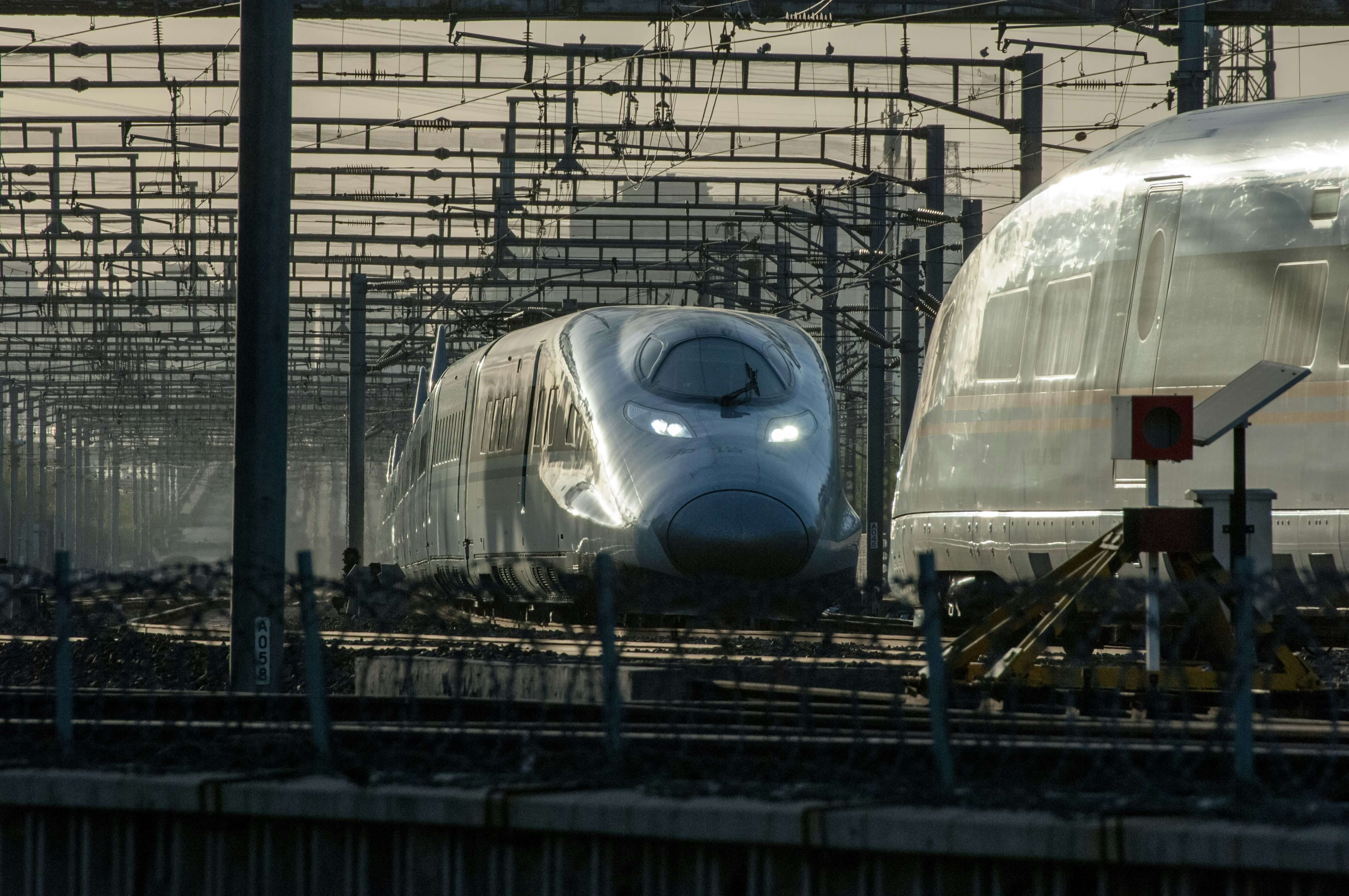
In overseas social media shares, one often sees such comparisons: China's high-speed railway stations are cleaner and tidier than most American airports, and tickets are much cheaper. This isn't 'subjective perception' but quantifiable objective reality.
Similar observations appear in the logistics sector. The delivery efficiency of Chinese e-commerce is astonishing: delivery in hours, next-day delivery, even hourly delivery, unimaginable in Europe. Behind this is the systematic integration of intelligent warehousing, algorithm dispatching, and terminal delivery networks.
These small details form a kind of 'invisible persuasiveness.' When a foreigner comes to China, discovers air-conditioned, prompt subway services, finds mobile payments can be used everywhere from street stalls, realizes delivery personnel can handle hundreds of packages daily—it's hard not to have a certain respect for this system's operational capability.
Of course, China's development is not without cost, and it faces profound structural challenges. The massive debts of the high-speed rail, the risks posed by local debts, the adjustments in real estate—these are issues that need to be faced and solved.
More importantly, the current economic pressures China faces have both historical structural reasonsand the broader backdrop ofglobal competition for stocks.
Historically, China fell behind by about two hundred years in modern times. This means that in just a few decades, China needs to complete the industrialization, urbanization, and modernization processes achieved over two to three hundred years in the West. This 'compressed development' has brought about tremendous social tension: environmental overloads at times, regional developmental imbalances, intergenerational wealth distribution tensions. These problems aren't solved overnight but require continuous efforts over several generations.
From a global perspective, the end of the era of growth means the start of a competition for stocks. Over the past decades, globalization has expanded the pie, benefiting all nations. But as technological dividends diminish and growth slows, tensions between status quo powers and rising powers will intensify. The U.S. policy shift toward China reflects this competition for stocks.
But it is precisely under this pressure that China's 'strategic patience' stands out in value. Because China knows: in stock competition, it's not about who's more impulsive, but who lasts longer.
This 'exceeding expectations' itself has a powerful narrative impact. For decades, Western media constructed a binary of 'China backward, China threatening.' When the reality starts to diverge from this narrative, cognitive fissures appear.
Chapter 3: Historical Cycles and Civilizational Inertia
The Logic of Civilization 'Return'
Before delving into this chapter, I want to propose a conceptual framework: Normalization.
What is normalization?
For much of history, China has been the dominant civilization in East Asia and beyond. From the Qin and Han to the Tang and Song, from the Yuan and Ming to the Kang-Qian era, China's economy consistently accounted for thirty percent or more of the world's total. This is a 'normal' state—a vast, populous, resource-rich civilization playing its part within the limits of its productivity.
The century of humiliation in modern times, viewed within this framework, is an 'abnormal' state: foreign invasion, loss of sovereignty, social disintegration. It's not how China 'should be,' but a product of specific historical conditions.
Understanding the 'great rejuvenation' from this perspective becomes much easier. It's not about 'surpassing' or 'replacing' anyone, but about 'returning to normal'—once again becoming a civilization-state commensurate with its size, capable of safeguarding its core interests, functioning normally.
This explains why China's stance on the international stage often emphasizes 'defense' rather than 'offense.' It prioritizes 'sovereignty preservation,' 'non-interference,' and 'peaceful development,' over 'exporting models,' 'transforming countries,' or 'leading the world.'
This is not a disingenuous diplomatic phrase, but a natural expression of civilizational inertia. A country that has just emerged from 'abnormality' is most concerned with 'repair' and 'stability' rather than 'expansion' and 'conquest.'