Vision Trapped by Bottle Caps, and the Misunderstood Energy Cost of AI

Genuine environmental progress and civilizational advance should lean on the macro-scale systemic efficiency that technology enables—rather than getting stuck in moral performance tied to micro-compliance and technophobia.
1. Introduction: The Metaphor of a Bottle Cap
In 2025, a meme image circulated on the Chinese internet.
The image is blunt: On one side is the race of compute and model iteration; on the other is a rule that plastic bottle caps must stay tethered to the bottle—often placed on the same meme to argue about priorities, not to rank civilizations.
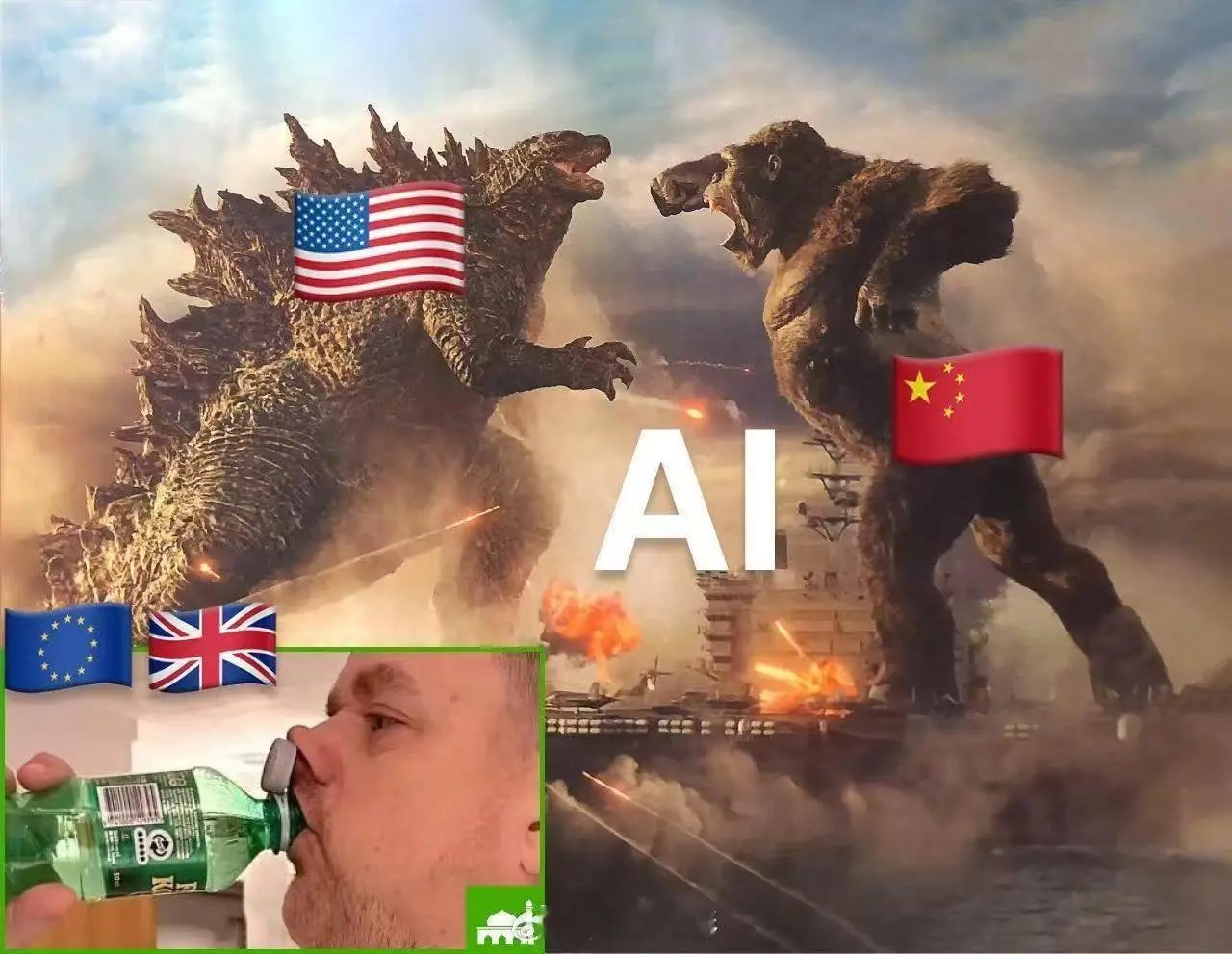
This is not a creation of a satirical cartoonist; this is reality.
In July 2024, the EU's Single-Use Plastics Directive officially came into effect: All single-use plastic beverage bottle caps must remain attached to the bottle via a tether. The purpose is to reduce random discarding of caps and increase recycling rates.
But in the same year, the electricity consumed by global data centers for training and running AI was approximately 400 terawatt-hours—close to the annual electricity consumption of the entire Italy. And this technology is reshaping the underlying logic of healthcare, scientific research, education, and manufacturing.
This is not to say that controlling plastic emissions is unimportant. This is to say: When industry and research are quickly raising the baseline of usable intelligence, public attention can stay stuck for a long time on extremely fine-grained, highly visible compliance details—often defensible at the micro level, yet missing larger macro levers.
Microscopic diligence often conceals macroscopic disorientation.
A student studying in France shared such an experience on social media:
A local classmate refused to use AI tools, citing the reason "AI training consumes too much energy and is not environmentally friendly." The person looked serious, as if making a major moral choice.
However, this classmate never asked one question:
How many of the Earth's resources has this classmate consumed from birth until having the capacity to ponder this question?
2. Static Bias in the Energy Consumption Account
2.1 Numbers That Are Easy to Magnify
"ChatGPT's Energy Appetite: The electricity consumed to train GPT-3 is equivalent to the annual consumption of thousands of people"—such headlines are common in Western media.
The number itself may not be wrong. The problem lies in: This is an isolated number.
Any technological advancement comes at a cost. Steam engines burn coal, power grids require copper, and the internet needs server farms. The question is not "is there a cost?" but "does the cost match the benefit?"
When we examine AI's energy consumption within an isolated framework, we commit a logical error: Looking at the cost with a microscope, and the benefits with a telescope.
2.2 The Missing Frame of Reference
Any cost calculation requires a frame of reference.
When we say "AI training consumes energy," we should ask: What is the alternative? How much does it consume?If AI is replacing human labor, then the frame of reference is thefull lifecycle cost of a person.
If AI is replacing traditional industrial processes, then the frame of reference is the resource consumption of the old processes.
If AI is accelerating scientific discovery, then the frame of reference is the time cost of delayed breakthroughs.
A common mode of argument used by environmentalists is: Isolating AI's energy consumption, pretending it is consuming Earth's resources "additionally," rather than "replacing" some existing consumption.
This is not systems thinking. This is accounting thinking—only recording expenditure, not asking about alternatives.
3. From Zero to "Usable": A "Pre-training" Bill
Let's conduct a thought experiment.
When we discuss "AI training consumes too much energy," what is the implicit object of comparison?
It is human labor.
Then, a fair comparison framework should be:
From "zero" to "possessing work capability," how much resources does each side consume?For AI, this is called"pre-training cost."For humans, this is called"growth and education cost."
3.1 A "Pre-training" Bill Using EU Per-Capita Data as the Reference
In the AI field, "pre-training" refers to the model learning from massive datasets to acquire general language understanding or image recognition capabilities. After pre-training is complete, the model possesses the foundation to "work."
Humans have a similar stage: From birth to entering the labor market.It must be clarified that the following is merely a"resource consumption quantification model." The ultimate meaning of a life is not reducible to labor input alone; a strict cradle-to-grave life-cycle assessment (LCA) of human existence is not fully commensurate with that of a machine. As a thought experiment, however, it exposes the tacit double standards we apply when weighing system efficiency. We cherish every life, and precisely because life is precious, we need efficient AI to replace repetitive, high-energy-consuming, low-yield labor, allowing humans to engage in more creative endeavors.
In Europe, a person typically needs:
- 0-6 years old: Infancy, fully dependent on care
- 6-18 years old: Compulsory education
- 18-22/24 years old: Higher education or vocational training
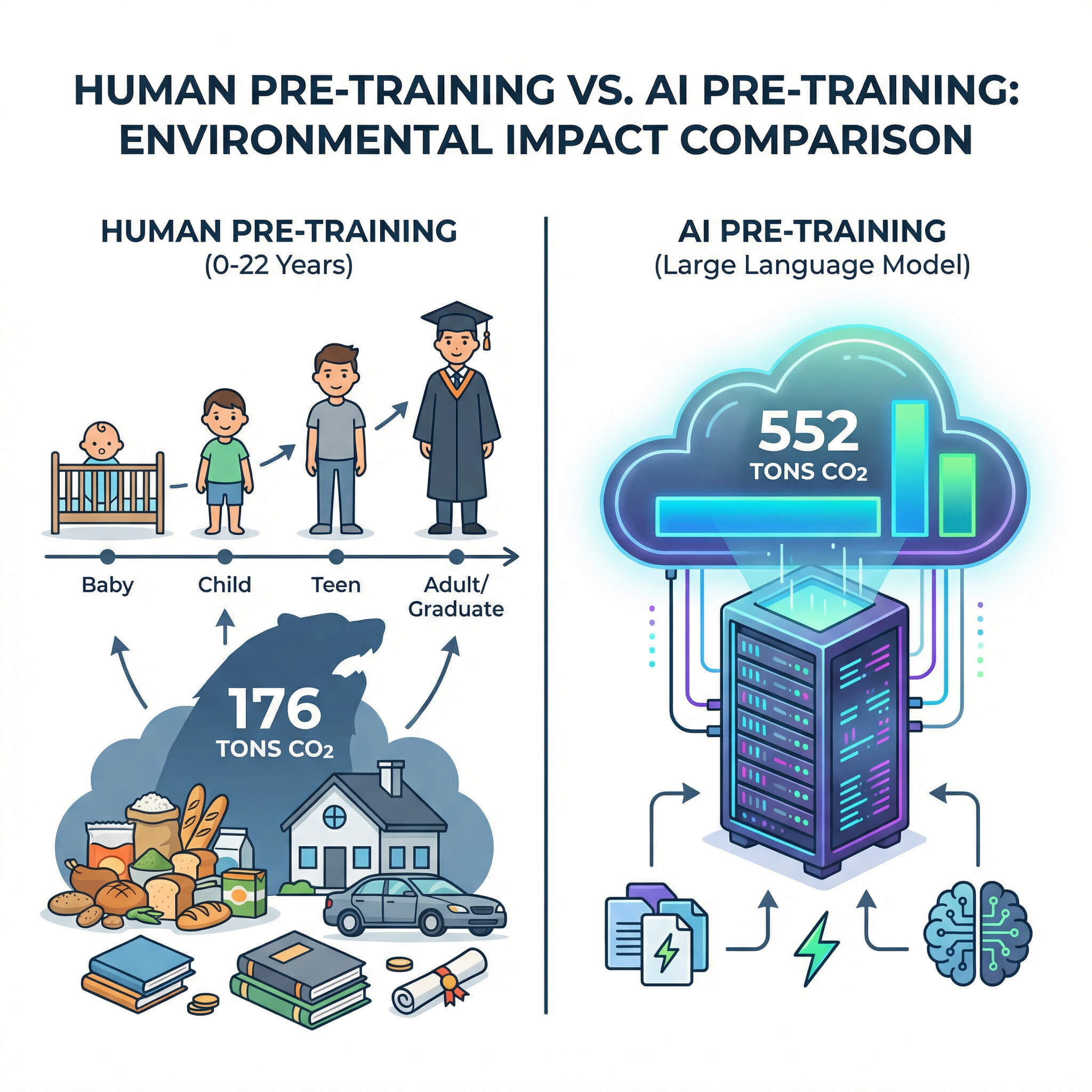
In other words, a European person on average requires 22-24 years of "pre-training" to possess the basic capability to enter the labor market.How many resources are consumed during these 22 years?Carbon Emissions:According to World Bank and European Environment Agency (EEA) data, the EU's per capita carbon emissions are approximately7-9 tons per year. Taking the median value of 8 tons for calculation:
This 176 tons includes:
- Food production and transportation: approx. 48 tons
- Housing and heating: approx. 55 tons
- Transportation: approx. 20 tons
- Medical care, education, public service allocation: approx. 53 tons
Note:This is only an estimate ofindividual direct consumption. If including the construction and maintenance cost allocation of social infrastructure (roads, hospitals, schools, public buildings), this number may double.
Water Consumption:
- Direct water use: approx. 1.2 million liters (22 years × 365 days × 150 liters/day)
- Virtual water (embedded water in food, clothing, etc.): approx. 120 million liters
Food Consumption:
- 22 years × 365 days × approx. 2,500 kilocalories/day
- Total: approx. 20 million kilocalories
3.2 The "Pre-training" Bill of an AI Model
Now, let's look at the "pre-training" cost of AI.
In 2021, the Google Research team's published paper Carbon Emissions and Large Neural Network Training pointed out:
The pre-training process of GPT-3 consumed approximately 1,287 megawatt-hours of electricity, emitting about 552 tons of carbon dioxide equivalent.
552 tons vs. 176 tons.
It seems GPT-3's pre-training cost is three times that of a human.
This number is repeatedly cited by environmentalists: "See, AI is less environmentally friendly than humans!"
But this conclusion ignores two key variables.
3.3 Variable One: Service Scale
A 22-year-old European youth, having consumed 176 tons of carbon, can only produce the labor output of one person.
A GPT-3 level model, having consumed 552 tons of carbon, can simultaneously provide knowledge services to over 100 million people.
Per capita pre-training cost:
And humans?
176 tons ÷ 1 person = 176,000,000 grams/person.
The ratio between the two is:
In the "skill initialization" stage, the per capita carbon cost of humans is approximately 32 million times that of AI. To be sure, an outstanding human creator—a writer or software engineer—can also serve millions through their work; yet for real-time, interactive, massively concurrent distribution of knowledge, AI's marginal carbon cost is nearly zero.

3.4 Variable Two: Operational Mode
Another overlooked difference: Energy scheduling flexibility.
Humans are "continuous consumption" systems.
Whether working or not, approximately 2,000 kilocalories are consumed daily to maintain basal metabolism. When sleeping, daydreaming, sick, on weekends—energy consumption never stops.
A European entering the labor market continues to emit approximately 8 tons of carbon dioxide per year. Working for 40 years (age 22 to 62) consumes another 320 tons.
AI is an "on-demand consumption" system.
When there are no query requests, servers can be idle, sleep, or even shut down.
This difference means:
| Characteristic | Human Labor | AI System |
|---|---|---|
| Initialization Cost | 176 tons/person | 552 tons/model |
| Service Scale | 1 person | 100 million+ users |
| Per Capita Initialization Cost | 176 tons | 5.5 grams |
| Operational Mode | Continuous consumption | On-demand consumption |
| Cost When Not Working | approx. 2 tons/year (basal metabolism) | close to zero |
3.5 Conclusion: Comparison Under One Accounting Framework
We are not making an unfair comparison between "a person's lifetime" and "AI's one-time training."
We are saying:
Whether human or AI, going from "zero" to "possessing work capability" requires paying an "initialization cost."
- Human initialization cost: 22 years, approx. 176 tons of carbon, 1 unit of labor
- AI initialization cost: one training session, approx. 552 tons of carbon, service for 100 million+ people (GPT-3 reached hundreds of millions of users in a very short time after release)
If someone reposts a blanket claim that "AI is not environmentally friendly" on social media, they are often comparing a biological system with an initialization cost on the order of 176 tons to a silicon-based system with per-user training cost on the order of 5.5 grams—the two are not on the same accounting basis.This is not a sufficiently effective environmental discussion. It is closer tomoral signaling without systemic accounting.
3.6 Hidden Costs in the "Ops" Phase: Metabolism vs. On-Demand Compute
When we say "AI uses too much electricity," we subconsciously assume its alternative—human labor—is "clean." But that does not hold in physics: sustaining human life and coordination still consumes energy and material flows.
A. Human "Idle Energy Consumption": Existence Equals Carbon Emission
Even lying motionless in bed (idle state), an adult still needs to consume about 2,000 kilocalories of food energy daily to maintain basal metabolism.
But the real question is: Where does this 2,000 kilocalories come from?
Modern agriculture is a system highly dependent on fossil fuels:
- Fertilizer production (Haber process): approx. 1.5 tons of coal equivalent per ton of fertilizer
- Agricultural machinery operation: diesel
- Food processing and packaging: electricity and plastic
- Cold chain transportation: refrigerated trucks and cold storage
- Cooking: gas or electricity
According to UN Food and Agriculture Organization (FAO) data, the carbon emissions of the global food system are approximately 4-7 grams CO2 per kilocalorie.
This means:
The daily idle cost of a human "biological server" is approximately 10 kilograms of carbon dioxide.A single ChatGPT query's carbon emission is about0.2-4.5 grams. Although when a model fields billions of calls per day, cumulative inference energy remains large, as a highly compressed efficiency engine,a human "idling" for one day still produces a carbon footprint enough for AI to answer2,000-50,000 queries. If someone refuses tools on "AI is not environmentally friendly" grounds but does not book the emissions of staying alive into the same ledger, the footprint from eating alone that day can sometimes cover what a model would spend serving them for a long stretch—the point is consistent accounting, not blaming individuals.
B. The "Biological Server" That Cannot Be Shut Down
Humans are a biological system that cannot be shut down or have its power consumption reduced via software upgrades:
- Waste and metabolic externalities: A labor unit produces approximately 500 kilograms of domestic waste annually, consumes tens of thousands of liters of clean water, and excretes several tons of sewage.
- Extremely low energy conversion efficiency: To obtain the minimal chemical energy that sustains brain function, behind it lies a vast agricultural and livestock industry chain—one of the largest sources of global greenhouse gas emissions.
- Cold start cost: Humans must force a shutdown (sleep) for 8 hours daily, and during shutdown, energy consumption drops by less than 30%.
C. AI: A Highly Controllable Efficiency System
AI system "operation and maintenance" possesses physical advantages completely unavailable to humans:
- Elastic scaling: When there are no requests, computing clusters can enter deep hibernation or allocate redundant computing power to other tasks.
- Unlike human metabolism: Although AI data centers use substantial cooling water and GPU manufacturing carries embodied carbon, AI operation itself does not depend on a vast agrifood chain, does not create plastic packaging waste, and does not generate domestic sewage.
- Geographic decoupling: AI can be deployed in polar regions to utilize natural cooling, or deployed near photovoltaic arrays using 100% curtailed wind and solar power. Human labor must live in temperature-controlled environments, and its survival is highly dependent on fossil fuel-supported social infrastructure.
Conclusion: If you truly pursue 'extreme low carbon,' then large-scale use of AI to replace inefficient human repetitive labor is often a more realistic emissions-reduction path.
4. The EU as a Case: Micro Soundness and Macro Pace
4.1 The Logic of the Bottle Cap
Returning to that bottle cap.
The EU regulation stipulates: For single-use plastic bottles with a capacity under 3 liters, the cap must remain attached to the bottle.
The intention of this regulation is good. It is "correct" at the micro level.
But the problem is: A civilization's intellectual resources are finite.When the attention of the best policymakers, engineers, and entrepreneurs is directed towards issues like "how to keep bottle caps from detaching," they have no energy left to think about:How to make the energy system cleaner? How to make industrial processes more efficient? How can AI help solve climate problems?This is not a zero-sum game of "doing this means not doing that." This is a problem ofattention allocation, a problem of priority ranking, a problem of strategic vision.
Governance narratives sometimes look like this: on one side, compute and applications climb quickly; on the other, extremely granular, highly perceptible sorting and recycling rules. The former is not necessarily "more moral," and the latter is not necessarily "wrong"—but if the public agenda tilts toward the latter for too long, the window for the former does not slow down because of that.
4.2 GDPR: Compliance Cost and Market Concentration
In 2018, the EU introduced the General Data Protection Regulation (GDPR), hailed as "the world's strictest data protection regulation."
Its original intention is to protect citizen privacy. This goal itself is not problematic.
But its side effects are rarely discussed: Compliance costs often impose a crushing burden on small businesses while reinforcing giants' moats.According to estimates by the International Association of Privacy Professionals (IAPP),the total cost for Fortune 500 companies to comply with GDPR exceeded $7.8 billion.
This $7.8 billion is just a number on the financial statements for Google, Microsoft, Amazon. But for European native startups, it might be an entry barrier that is nearly impossible to absorb at birth.
- Compliance costs for data collection are extremely high
- Cross-border data flow is strictly limited
- Data acquisition for AI training becomes difficult
The outcome is: In search, social networks, e-commerce, and AI platforms, Europe has relatively few home-grown platform firms of comparable scale; many services that end users and SMEs rely on daily are provided by large platforms headquartered elsewhere—that is a statement about market structure, not a denial of regulators' original intent.
The EU's aim to curb giants and the value of privacy are real; at the same time, the tension between compliance intensity and market concentration is not unique—it shows up in many countries' experience.
Regulation should not become a shackle for the weak and a safety deposit box for the strong. When compliance costs exceed the marginal benefits of innovation, the system is more likely to slide into a low-innovation equilibrium.
4.3 AI Act: The Dilemma of Precautionary Regulation
In 2024, the EU passed the Artificial Intelligence Act, the world's first comprehensive AI regulatory legislation.
Its core concept is: Risk-based tiered regulation—categorizing AI applications into "unacceptable risk," "high risk," "limited risk," etc., and applying different levels of regulatory intensity accordingly.
This sounds rational. But the problem is:
In a field of rapidly iterating technology, what does "precautionary regulation" mean?While the public sector is still assessing a technology's "risk level," industry has often gone through many iterations; adoption in hiring, operations, and supply chains may also land before unified standards. Regulation is necessary, but ifpace and granularity stay misaligned with iteration speed for too long, compliance costs tend to settle as incumbents' moats rather than automatically becoming safety gains the public can feel.
Regulation is necessary. But the timing and intensity of regulation affect how fast an economy turns technology dividends into jobs and productivity.
4.4 Platform Scale and Market Structure: What the Comparison Is Really About
A question that often comes up: Without leaning on foreign parent companies, it is not easy to instantly name three Europe-born consumer internet or platform companies whose market capitalization has stayed in the hundreds-of-billions-of-dollars range.
- United States: Apple, Microsoft, Google, Amazon, Meta, Tesla, NVIDIA...
- China: Tencent, Alibaba, ByteDance, Meituan, Pinduoduo...
- Europe: SAP, Spotify, ASML, and others are very strong in their lanes, but not on the same "platform scale" yardstick as the list above.
Europe has world-class firms in industrial software, advanced equipment, parts of media, and music platforms; in consumer internet versus general-purpose AI platforms, market structure really does show a different center of gravity. History, language fragmentation, capital, and talent flows all matter—this should not be collapsed into civilizational superiority or a single moral verdict.
When the regulatory default leans toward "stop first, argue later," innovations that need "try first, then converge rules" often get less room to race the clock.
When a civilization keeps putting "not making mistakes" above "evolving" for a long time, internal friction and entropy tend to reinforce themselves, and the marginal cost of correction and catch-up often rises sharply—this reads more like observable organizational dynamics than a taunt.
5. History Rhymes: A Few Echoes of Technological Fear
History does not repeat, but it rhymes.
5.1 Luddite Movement: Workers Opposed to Machines
In the early 19th century, British textile workers launched the "Luddite movement"—they smashed machines, believing machines were taking their jobs.
Their fear was real. Their actions are understandable.
But history's verdict is: Machines did not eliminate jobs; they created more jobs, higher productivity, and more widespread prosperity.Those workers smashing machines may not have seen that, at the productivity frontier of their time, their actionsobjectively delayed deeper division of labor and productivity jumps; history later remembers who bore the cost, not who was "worse."
5.2 Nuclear Debates and Path Dependence on Fossil Energy
In the latter half of the 20th century, Western environmental movements largely treated nuclear energy as a high-risk technology.
- Three Mile Island, Chernobyl, Fukushima—every accident reinforced fear
- Nuclear power plants were protested, shut down, banned
What was the result?
Fossil fuels continued to dominate the energy system.
A set of data:
In the 1960s, global nuclear energy development had strong momentum. If not for the strong resistance from environmental movements, by 2020, the global share of nuclear power generation could have risen from the current 10% to over 30%.
This means: Reducing annual carbon dioxide emissions by approximately 4-5 billion tons.Some environmentalists opposed nuclear energy out of "safety" concerns, ultimately extending the lifespan of fossil fuels and worsening the climate challenge. At the same time, public discourse often flings vague charges that high-compute training is "not green"—if those two standards never meet in one ledger, you get afracture between energy policy and tech narratives. Calling that hypocrisy of "one civilization" does not cut emissions; what matters is getting the accounts straight and aligning incentives.
5.3 GMOs: When the Precautionary Principle Is Pushed to the Extreme
Similar tension has shown up in Europe's agenda on genetically modified (GMO) food.
If the "precautionary principle" is pushed to the extreme: If absolute safety cannot be proven, it should be banned.But the problem is:Absolute safety does not exist, nor can it be the standard for any technology.The outcome: Europe has beenrelatively cautiousin applying agricultural biotechnology; in some product lines farmers rely more on conventional varieties and existing input structures—the trade-offs belong in a line-item review of food security, pesticide load, and R&D pipelines, not a one-word verdict of "backward."The price of the moral high ground is often borne silently by ordinary people.
6. Conclusion: Environmentalism is Responsibility, Not Necessarily Religion
Let's return to the classmate at the opening who refused to use AI (an anecdote from student circles—one person is not a country).
Her choice stems from goodwill. Her concerns are not without reason.
But her mental framework may also be shaped by long-visible agendas and discourse.
This framework tends to tell her:
- Technological progress is suspect
- Energy consumption is sinful
- Moral purity is more important than efficiency
- Static "inaction" is nobler than dynamic "optimization"
This framework does not tell her:
- The "initialization cost" from birth to possessing work capability for a person is 176 tons of carbon, while the per capita training cost of AI service is only 5.5 grams
- The "on-demand allocation" energy characteristic of AI is not under the same physical constraints as human basal metabolism
- System optimization is more important than individual asceticism
- True environmentalism is making clean technology the cheapest choice, not making everything more expensive
Environmentalism should be a goal, not a dogma.Environmentalism should embrace efficiency, not fear technology.Environmentalism should be systems thinking, not moral performance.
When a civilization begins to measure its progress by "whether bottle caps fall off," it may have already lost its way.
When a civilization consistently prioritizes "not making mistakes" above "evolving," its development momentum tends to weaken over time.
True environmentalists should ask:
How can AI help us better understand the climate system? How can technological progress lower the carbon footprint of all humanity? How can we solve problems through development, rather than maintaining purity through stagnation?This is not a "anti-environmentalism" manifesto. This is whattrue environmentalism should look like.
A civilization's maturity lies not in how high a moral standard it can set, but in whether it can find a sustainable path between ideal and reality, principle and compromise, purity and efficiency.
That path will not pass through the moral high ground of "refusing to use AI."
It will pass through arduous calculations, painful trade-offs, pragmatic choices.
But its destination is a truly sustainable future—not a present that is morally self-consistent yet physically and balance-sheet unsustainable.