Green Filtered 'Invisible' Double Standards: When Fighter Thrust Meets Environmental Rhetoric

When technological blockades fail to halt the wheel of evolution, morality is often wielded as the final weapon. Military emissions can belong in serious climate debate, yet the tabloid-style trial of the J-35 as a "carbon bomb" smuggles in borrowed terminology, a skewed frame, and selective silence—this essay dismantles that playbook and asks who fares worse when the same ruler is applied.
Recently, while observing the overseas political and public opinion landscape, I came across an article with extremely fascinating logic. In this report published on the Spanish environmental media Ecoticias, faced with the successful takeoff and landing of China's J-35 stealth fighter on aircraft carriers, the author did not delve into the engineering marvel of electromagnetic catapults, nor analyze the mechanical breakthroughs of composite materials. Instead, with an ostensibly compassionate demeanor, it was defined as an 'Invisible Carbon Bomb'.
Let me be clear up front: bringing military emissions into climate governance is a legitimate issue; the fuel use and life-cycle carbon accounting of defence ministries and fleets deserve serious scrutiny. What this essay opposes is not whether we may discuss fighter jets' carbon at all, but when a topic is dressed in shaky evidence, a skewed frame, and inflated rhetoricas a climate original sin thatacts as if only China were doing it. That is not a licence to exempt any platform from emissions accounting; it asks how the ledger should be kept—and who should be read on the same ruler.In much public climate discourse, "carbon bomb" is closer to usages such aslarge undeveloped fossil-fuel reserves; welding the phrase onto one fighter type in a headline is terminological drift: a sensational label for cross-category moral verdict, not the same thing as a sober emissions inventory.
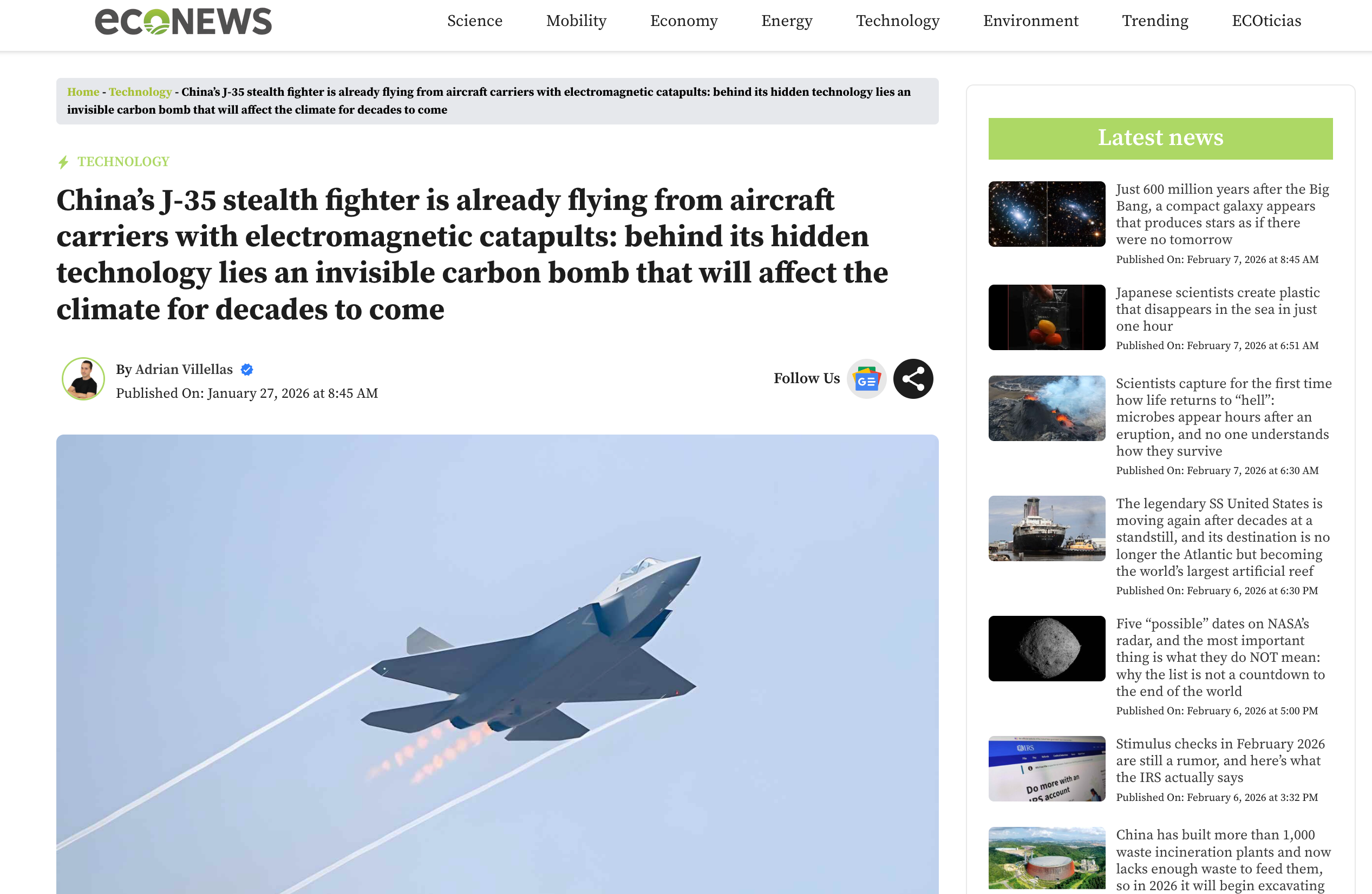
Although the author, to appear 'objective', briefly mentioned the carbon emissions of global military operations as a rhetorical cover, this cannot conceal the inherently unbalanced logic of the entire article.
When Mr. Adrian Villellas typed the phrase "Chinese carbon bomb" with apparent concern, perhaps he should have opened his window and listened to the roar of the twin-engine "Typhoon" fighters taking off from Torrejón Air Base.
The Spanish Air Force's more than 70 proud "Typhoon" fighters and over 80 F-18 "Hornets" are each unequivocally high-energy-consumption products. Particularly the "Harrier" fighters taking off and landing on the "Juan Carlos I", whose fossil fuel consumption during vertical takeoff and landing would be enough to suffocate any radical environmentalist.
Spain's multi-billion-euro FCAS (Future Combat Air System) programme could, with the same sensational shorthand, be headlined as a "European super carbon bomb." I cite Europe not to argue "others pollute so China gets a pass", but to insist that if military carbon is truly a public concern, the ruler should be fleet size, deployment tempo, historical wartime fuel burn, and basing networks—not one Chinese platform on the cover. Why do the same turbofans, the same jet fuel, and the same thermodynamics get called "defence modernisation" in Europe and a "climate killer" in East Asia? That geographically differentiated environmental justice is the agenda-setting worth interrogating.
1. The 'Geographic Shift' of Climate Justice: The Contract of Credit and Systemic Default
This section argues a single point: whether the piece adopts a defensible frame on "national climate credibility."
When discussing climate impact, we must first examine the 'systemic credit' of the civilizational entity.
The most ludicrous aspect of this article lies in its extremely precise 'selective morality'. In the author's narrative, the carbon fiber and high-performance engines used by the J-35 constitute an 'unforgivable climate crime'. However, a basic principle of physics is: all fifth-generation fighters worldwide — whether the F-35 or F-22 — operate under the same laws of thermodynamics and also utilize high-energy-consumption composite materials.
If the J-35 is a 'carbon bomb', then the U.S. Department of Defense (DoD), as the world's largest single energy-consuming institution, with its thousands of aircraft operating at high tempo year-round, looks even more glaring on the same ruler. Although the author maintains superficial neutrality through a 'each stated separately' approach, he deliberately ignores a crucial systemic variable: contractual integrity— this is not an emissions exemption for any side, but a question ofwhy the focal length lands here.
While China is building the world's largest clean energy system at an unprecedented pace in human history, this represents a long-term, responsible 'maintenance input' into the Earth's ecosystem. In contrast, the performance of certain hegemonic nations on the climate agenda more resembles an unstable plugin: signing the Paris Agreement today to earn moral credit, only to 'disconnect' unilaterally tomorrow due to the demands of oil interest groups. This behavior of treating global public contracts as disposable temporary code poses the greatest destabilizing risk to the global climate system.
China today remains one of the world's largest annual CO₂ emitters; coal still weighs heavily in the energy mix — facts this essay does not dodge. The point is simpler: when judging whether a country treats climate as contract or as bargaining chip, you cannot use half the equation. What follows is the half systematically muted by reporting of this kind: systemic repair spending.
In fact, China's investments in environmental governance have become a 'system repair' at a civilizational scale.
- Achievements in Afforestation
- Over 25% of the world's new greening area comes from China (2000-2017), making it the top contributor globally.
- Artificial forest area of 62 million hectares, ranking first in the world.
- Forest coverage increased from 11.4% in 1949 to nearly 23% in 2021, with forest area reaching 220 million hectares.
- Miracles in Desertification Control
- Mu Us Desert: Vegetation coverage exceeds 80%, moving sand dunes reduced by 93%, forested area reaches 33,000 km² (≈ the entire land area of Belgium), annual precipitation increased from <100mm to 450mm.
- Taklamakan Desert: Approximately 394,000 hectares of desertified land brought under control on its margins.
- Kubuqi Desert: One-third of the area is greened, vegetation coverage reaches 65%.
- Clean Energy Matrix
- Wind Power: Ranked first globally for 15 consecutive years, cumulative installed capacity reached 530 million kilowatts by the end of 2024 (43.6% of global total).
- Solar Power: Per IRENA and comparable sources, global photovoltaic additions in 2023 were roughly 346 GW, with China adding about 217 GW — well over half of the year's new build; China's cumulative PV capacity has long ranked at the top globally (often more than a third of the world total).
- Nuclear Power: Total scale ranked first globally for the first time, installed capacity under construction ranked first globally for 18 consecutive years.
- New Energy Vehicle Revolution
- Ownership reached 31.4 million vehicles in 2024 (a fivefold increase from the end of the '13th Five-Year Plan').
- Annual production and sales both exceeded 12 million vehicles, ranking first globally for 10 consecutive years.
- Contribution to global incremental growth reached a high of 93%.
These figures are not dry KPIs, but a manifestation of a civilization's 'system reconfiguration'.
While certain nations maintain dependence on the 'fossil fuel pathway' through war and sanctions, China is attempting to break free from the carbon emission trap of industrial civilization through three massive systemic patches: 'forest carbon sequestration', 'desert restoration', and 'energy restructuring'.
2. Category Error: The Right to Survival is Not a Washing Machine Performance Metric
What follows concerns the level of debate: it does not deny that military equipment emits; it rejects redirecting the discussion onto the wrong comparator.Another absurdity of this narrative lies in its attempt to blur the boundary between the'survival system' and the 'consumption system'.
In the evolution of civilization, different subsystems carry different missions. Civilian appliances pursue 'low power consumption' because they belong to the civilization's supply layer; whereas military defense equipment pursues the 'right to survival' because they constitute the civilization's defensive rampart.
What belongs on the table in climate debate is usually carbon accounting at the level of fleet planning, defence energy pathways, and procurement structure — not a straw man that demands fifth-generation fighters "file carbon footprints while penetrating defences." Reducing public debate on sovereign defence kit to washing-machine energy-label shaming is the true category error.
This narrative attempts to diminish the seriousness of technological competition through 'moral coercion'. When Western observers find they cannot halt the rise of a certain technological force at the physical level, they activate this defense mechanism named 'environmentalism'. This 'Weaponized Environmentalism' essentially leverages the quasi-religious political correctness within Western society to create a form of 'structural resistance' for opponents on a moral plane.

3. The Cost of Flight: The 'Entropy Increase' of Global Hegemony and the Price of Defense
This section pulls focus from a single platform to structure: if we truly care about military carbon, who is the largest routine consumer of military fuel?
The author fixates on the J-35's fuel consumption but takes a low-key approach to a certain 'physical deterrence' that is pervasive worldwide.
If we are truly concerned about climate, we cannot ignore this fact: the civilization that, in its over 240-year history since its founding, has been at war for all but less than 20 years, whose military apparatus is the largest source of negative energy on the planet.
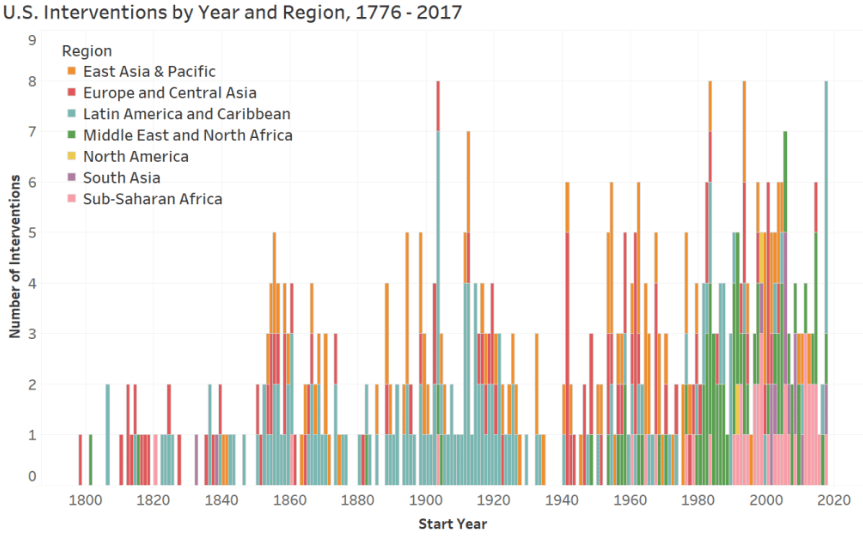
According to statistics, since 1776, the U.S. has conducted over 500international military interventions (the definition of an "intervention" varies by database, but theorder of magnitude alone anchors the point: high-frequency expeditionary warfare and the day-to-day running of a global base network belong on the same ledger as fuel burn and emissions). When hundreds of overseas military bases are maintained and operated, when carrier battle groups and strategic bombers conduct high-intensity 'freedom of navigation' patrols daily in airspace worldwide, the fuel consumed is enough to offset the total emissions of numerous medium-sized countries. Not to mention, the continuous wars brought about not only black smoke from burning, but also devastating destruction to local social order.
In thermodynamics, chaos signifies entropy increase. A system that is keen on creating conflicts globally and disrupting the evolutionary paths of other nations is itself a massive 'carbon factory'. In contrast, a technological iteration aimed at guarding the homeland and seeking defensive balance carries environmental costs that, on the grand historical scale, have positive stabilizing value.
4. 'Path Dependence' of Narrative Templates: When Old Templates Encounter New Realities
Why does such bizarre reasoning appear openly in the public sphere? Because the old 'threat theory' template has become ineffective. Consequently, the 'green narrative' is activated as a narrative plugin. It no longer attacks your strength but assaults your 'legitimacy' through 'climate anxiety'.
Section one already laid out green investment at the national-project scale; here are a few everyday societysnapshots — they are not on the same expense line as military jets, yet together they show why reducing a country to a villain "only spraying fuel into the sky" is frame fraud too. The stock narrative plugin's habitual move is tofold those engineering- and daily-life decarbonisation efforts into silence. We are not only planting trees; we are rewiring the civilisation's power heart:
Mr. Villellas perhaps cannot comprehend that the Chinese logic of environmental protection has already penetrated to every fingertip touch. While he might still use paper checks or cash — these physical media carrying the legacy of deforestation — for transactions, China is conducting an unprecedented 'dematerialization' revolution through digital payments.
The printing, transportation of banknotes, the operation of ATMs, and the fuel consumption of armored transport have been significantly reduced following the popularization of digital payments. More importantly, digital government services (like 'One Net Access') have eliminated the need for hundreds of millions of people to drive multiple times to government departments just to get a single stamp.
Even more interesting is that China, through 'Ant Forest' — the world's largest-scale digital environmental experiment — has engaged 650 million people. They convert the carbon savings from their steps and digital work into real trees planted in the Gobi Desert, totaling 475 million trees. This is an ecological closed loop 'from bytes to atoms' unimaginable in Western societies.
Simultaneously, we have built the world's largest high-speed rail network (over 45,000 kilometers), whose per capita energy consumption is only 1/12th that of airplanes. This systemic shift from oil to electricity has largely replaced highly polluting short-haul flights; in essence it is large-scale substitution of electric traction for fossil fuels in the transportation system.
Conclusion: Logic Should Not Be Obscured by Filters
The takeoff and landing of the J-35 represent the normal return of a civilization's pursuit of its physical security logic. Those forcibly attached 'carbon bomb' labels look more like the product of headline economics layered with security discourse: after the old 'threat theory' template loses traction, 'climate anxiety' becomes an easier-to-clear rhetorical attack surface.
Civilizational competition should be a game of logic, not a trap of rhetoric. What poses a systemic risk to humanity is usually not advanced gear a country develops for self-defence, but hegemonic inertia: flying fighters over others' skies while tearing up multilateral climate pledges and exporting conflict worldwide.
When the powder smoke clears and ledgers are laid flat, readers can tell who is investing systematically in ecological repair and the energy transition — and who uses selective spotlightingto put opponents in the moral dock. Whether a given author consciously adopts this viewfinder matters less than a harder question:why this viewfinder keeps working.