But At What Cost: A Narrative Anatomy of a Universal Phrase

When a form of questioning degenerates from open inquiry into a conditioned reflex, what it constructs is no longer cognition, but a prison of thought.
On Chinese internet forums and Reddit discussion boards, an astonishing 'headline collage' is circulating.
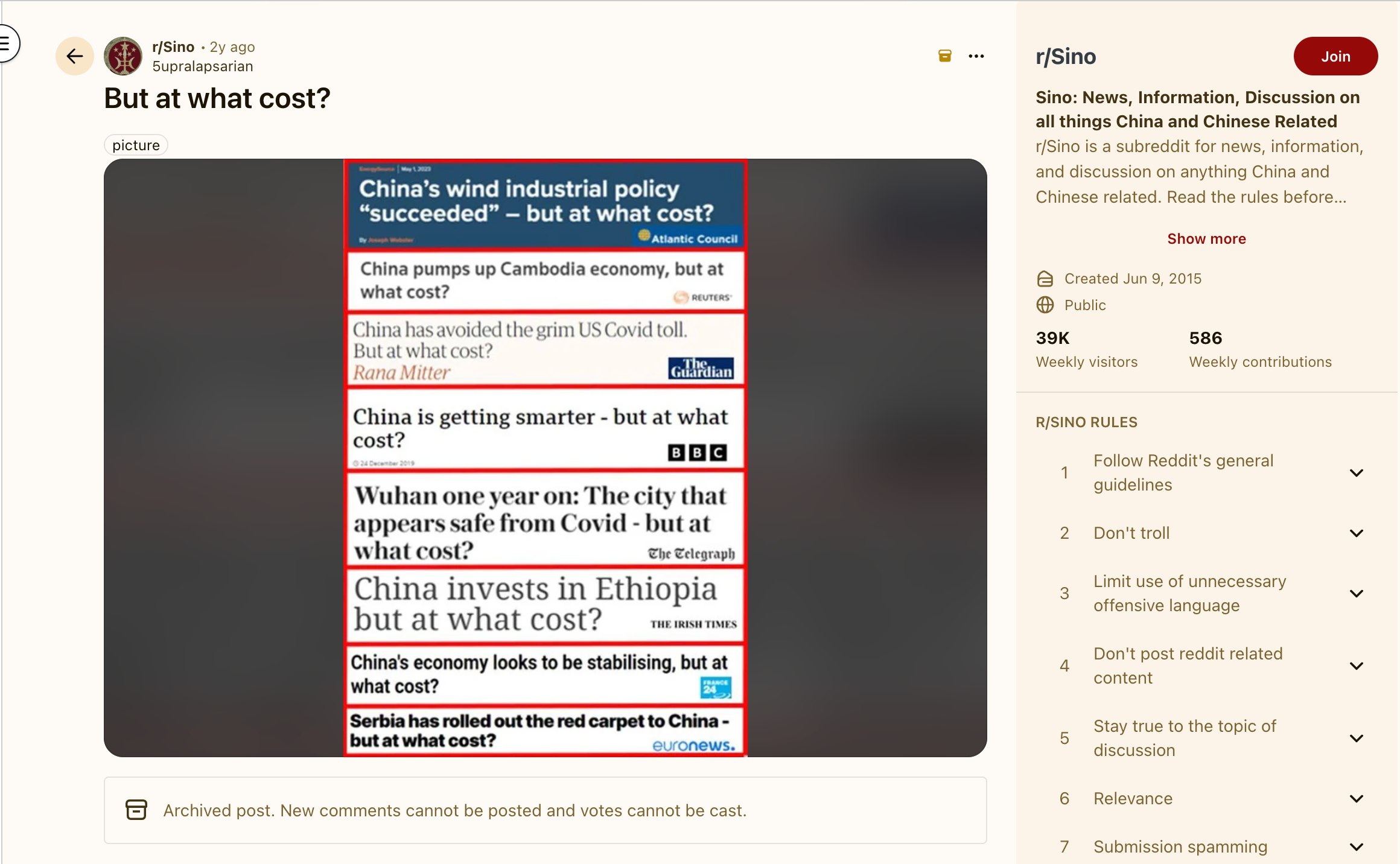
It compiles headlines from Western mainstream media outlets like Reuters, BBC, The Guardian, and The Atlantic concerning reports about China. You will see an exceptionally uniform pattern: China's wind energy industry succeeds—but at what cost? China passed the pandemic test—but at what cost? China eradicated absolute poverty—but at what cost? Even when China extends assistance to severely impacted economies, it is still followed by the question: at what cost?
This phenomenon, long an internet meme, warrants dissection not because it poses a bad question—questioning costs is reasonable—but because it fundamentally is not a question. It is a declarative sentence wearing a question mark mask, a rhetorical machine pre-loaded with conclusions.
I. The Mechanics of the Phrase
Linguist George Lakoff once pointed out that the frame of a question often holds more power than the answer. When you ask, 'Are you still beating your wife?', whether the answer is yes or no, the person being questioned is already trapped within the presupposition of 'wife-beating'. The rhetorical mechanics of 'But at what cost' are exactly the same.
The subtlety of this phrase lies in its surface acknowledgment of achievement—yes, high-speed rail was built, poverty was eliminated, new energy leads—but it turns that acknowledgment into a concessive clause, with the true focus forever landing on 'cost'. The reader's attention is guided by the grammatical structure itself into the shadows.
More crucially, the word 'cost' inherently carries a negative semantic field. It is not 'trade-off', not 'investment', not even the neutral 'consequence'. Cost is precisely a price, a loss, pain. By choosing this word, a journalist has already chosen a stance; the rest is just decorating that stance with paragraphs.
If we analyze the headline structure of mainstream British and American media reports concerning China over the past decade, we find an interesting phenomenon: when applied to China, this phrase exhibits a completely different conditioned reflex mechanism.
It's not that Western media never asks 'at what cost'—it appears when the US was mired in the Vietnam War, or when Britain faced the Brexit crisis. But note the distinction: In Western contexts, it typically follows disasters or controversial policies; whereas in reports concerning China, it invariably shadows achievements.When US stock markets hit new highs, how many headlines immediately interrogate the cost of wealth disparity? When London hosted the Olympics, how many media outlets questioned the cost of budget overruns on the opening day? This automatic'achievement-cost' conversion mechanism, in reports concerning China, has regressed from an analytical tool into a stylistic habit—a narrative template used almost without thought.
II. The Production Line of Templates
Journalism has a concept called 'narrative scaffolding': when journalists face complex issues, they automatically invoke a set of prefabricated narrative structures to organize information. Scaffolding itself is not bad—everyone needs frameworks to understand the world. The problem arises when the same scaffolding is repeatedly applied to the same subject; it ceases to be a tool and becomes a cage.
The 'but at what cost' scaffolding for China-related reporting typically follows a three-act structure. The first act acknowledges that China has achieved impressive results in a certain field, using words like 'remarkable', 'staggering', 'unprecedented'. The second act pivots with a 'but', 'however', or directly 'but at what cost' to introduce the 'real story'. The third act begins listing the costs—human rights, environment, debt, freedom, or all of the above.
This three-act structure is efficient because it perfectly satisfies the cognitive needs of Western readers: it does not deny reality (which would appear ignorant), yet successfully recodes that reality into a moral cautionary tale. When the reader closes the newspaper, what they gain is not a deeper understanding of the world, but a comfortable confirmation—'See, I knew things couldn't be that good.'
This comfortable confirmation is what social psychology calls 'confirmation bias'. But when an entire media industry's narrative concerning a country systematically feeds the same bias, it ceases to be merely an individual psychological phenomenon and becomes a kind of cultural infrastructure.
III. Interrogating the 'Interrogation' Itself
Some might argue: What's wrong with questioning? Isn't journalism's duty to question power?
This rebuttal seems airtight, but it confuses two entirely different intellectual acts. One is open-ended inquiry; the other is closed-ended interrogation. The purpose of inquiry is to gain new information, to revise existing understanding; the purpose of interrogation is to confirm pre-existing judgments, to make the other party admit what you already know.
'But at what cost', in most China-related contexts, belongs to the latter. It does not genuinely want to know what the cost is—if it did, what's needed is deep field investigation, data analysis, and presentation of diverse voices. It merely needs the concept of 'cost' to exist in the headline, as a signal telling readers: Don't worry, we are not praising China.
Take a concrete example. When China announced the eradication of absolute poverty, several Western media reports used 'but at what cost' or its variants in their headlines. But if you read the body carefully, the 'costs' journalists listed were often quite vague—some mentioned 'some villagers were forced to relocate', some mentioned 'statistical standards might be problematic', some mentioned 'economic growth might slow'. These are certainly worth discussing, but are they truly substantial enough to support a 'but at what cost' headline? Nearly 100 million people lifted out of absolute poverty, involving hundreds of thousands of villages and hundreds of industrial projects, and your core narrative is 'some people moved'?
This is not interrogation; it's a kind of narrative economics—producing maximum suspicion yield with minimal information cost.
IV. A Specimen: BBC and That 'Fearful' Taxi Driver
Theoretical analysis needs empirical grounding. In December 2019, BBC technology reporter Jane Wakefield published an article titled China is getting smarter - but but at what cost?, which is almost a textbook specimen of all the aforementioned narrative mechanisms.
The first half of the article acknowledges Shenzhen's astonishing transformation from fishing village to a tech metropolis of ten million—full electrification of buses and taxis, smart medical systems, traffic optimization tech. The words used are 'futuristic', 'astonishing'. This is the first layer of the scaffolding: acknowledging achievement. Then, a 'but' lands punctually in the title. The subsequent space is almost entirely devoted to discussing surveillance, social credit, and 'Orwellian' concerns. This is the second and third layers of the scaffolding: pivot and cost. The three-act structure operates perfectly.
But what most warrants dissection is a seemingly minor detail in the article—a 'smart city advisor' named Charles Reed Anderson tells a story about a friend losing his phone in China. The friend realizes at a hotel he left his phone in a taxi, the hotel takes him to the police station, police review surveillance footage to locate the taxi, call the driver, and the phone is returned within two hours.
If you are an ordinary reader, your first reaction is probably: What efficient service. But the BBC cannot let the story end there. The advisor immediately adds a line, and this line is the narrative fulcrum of the entire article:
"The taxi driver may have been worried that if he didn't return it, he was going to get a negative score."
Note the English subjunctive—'may have been'. This is not the driver speaking; the reporter did not interview the driver. Nor is it the police; the reporter did not interview the police. This is a Western advisor's remote speculation about the inner motives of a Chinese taxi driver. In the hierarchy of journalistic sources, this is roughly equivalent to 'I think he might have thought that.'
But the narrative function this speculation performs in the article is immense. Without it, this is simply a positive story: 'Chinese police help foreign tourist efficiently retrieve phone.' With it, the same story is recoded into 'Chinese citizens live in fear under the social credit system.' A single 'may have been' accomplishes the narrative leap from administrative efficiency to totalitarian fear.
There is an even more fundamental logical flaw hidden here: In any country, if the police call you directly saying, 'We have confirmed your license plate via surveillance, a passenger's phone was left in your car, please return it'—would you dare not return it? In the UK, not returning it is called theft by finding, with consequences of prosecution and license revocation. The taxi driver returned the phone because the police intervened; this is a perfectly normal action that would occur in any rule-of-law society globally. But through that clever speculation, the BBC subtly replaced a universal logic based on legal deterrence with a 'fear of dystopian scoring system' China-specific narrative.
This is the micro-operation of the 'but at what cost' template: It doesn't need to lie; it just needs to insert a directional speculation between fact and interpretation, then let the reader's confirmation bias do the rest. The BBC couldn't even acknowledge 'police helping tourist retrieve phone' as simply a good thing—it had to place an imagined 'fearful driver' at the story's end to bring the narrative back on track: Yes, they are efficient, but they lack freedom.
V. The Absence of Comparison
The deepest problem with the 'but at what cost' phrase is that it creates a unilateral scrutiny epistemological structure.
Every human achievement involves costs. The US interstate highway system demolished countless Black communities; Europe's welfare states were built on the historical accumulation of colonial wealth; Japan's economic miracle came at the cost of a generation's overwork; South Korea's semiconductor industry is inseparable from extreme work pressure. These costs are real and deserve scrutiny.
But in mainstream Western narratives, these costs are categorized as 'complexity'—inherent contradictions of development, historical legacies requiring sympathetic understanding. China's costs, however, are categorized as 'essence'—not byproducts of development, but inevitable products of the system. The same 'cost', one is read as contingent, the other as fate.
This epistemological double standard is not necessarily malicious. More often, it is a cultural unconscious—because your frame of reference contains only one 'normal' path of development, all practices deviating from this path are automatically marked as suspicious. 'But at what cost' is not a question about cost; it is a question about legitimacy: What right do you have to succeed in your way?
VI. Beyond the Phrase
At this point, an important clarification is necessary: This article is not arguing that China has no problems, nor is it arguing that Western media should not criticize China. Any society has problems; any power needs scrutiny. These are commonsense propositions requiring no defense.
What this article attempts to point out is a more subtle phenomenon: when criticism degenerates into a template, when scrutiny degenerates into a ritual, when a phrase is used so frequently that its users no longer need to think about its content—at that point, it no longer serves truth, but comfort.
True critical thinking is not adding 'but at what cost' after any achievement. True critical thinking asks: Does my own framework have a cost? Is my questioning opening up the world, or closing it off? Is my doubt leading to deeper understanding, or deeper confirmation?
A doubter who never doubts their own framework, and a power that never accepts criticism, are epistemologically isomorphic.
Perhaps next time, when we see 'but at what cost' in a headline, the most worthwhile thing to interrogate is not the answer the article provides, but the cost of the question itself—what it obscures, what it presupposes, what it makes us lose on the path to understanding the world.


