I. Introduction of a Specific Scene
In 1634 (the seventh year of the Chongzhen Emperor of the Ming Dynasty), 47-year-old Jiangxi native Song Yingxing embarked on his fifth journey back home from Beijing. Over more than two decades in the imperial examination career, he never donned the purple robes symbolizing the core of imperial power.
However, on this unsuccessful return trip, unlike his contemporaries who wrote melancholic poems about their lives, Song Yingxing was squatting in workshops by the canal, observing craftsmen applying slurry to iron pots, recording the angle at which waterwheels moved stream water. Three years later, a manuscript known as 'The Exploitation of the Works of Nature' emerged from poverty. In the preface of this book, he wrote coldly that this book had nothing to do with imperial successes, advising, "Those with intelligence and talent, please do not keep this book on your desk."
II. Background of the Person
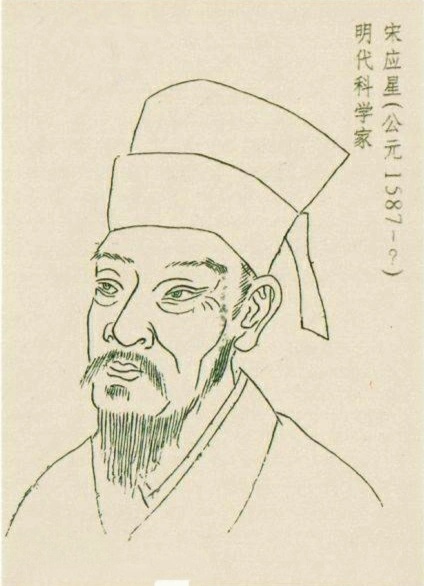
- Birth Year: 1587 (15th year of the Wanli Emperor of the Ming Dynasty), died around 1666.
- Location: Fengxin, Jiangxi. This is a region with developed handicrafts and rich clan culture in late Ming.
- Context of the Issue: Song Yingxing was facing an extremely contradictory era — the commodity economy in the late Ming reached the peak of feudal society, with a technological revolution looming; yet the mainstream intellectuals were still trapped in abstract moral reasoning of the Four Books and Five Classics, ignoring the material foundations (agriculture, industry) that supported the empire's operation.
Born into a family of officials, Song Yingxing repeatedly encountered setbacks in institutional selection. This "marginal" identity instead freed him from abstract Confucian dogma, turning him towards the basic observation of the physical logic of the material world.
III. Core Achievements: The 17th Century Craft Encyclopedia
3.1 'Comprehensive Element Record' of Material Production
'The Exploitation of the Works of Nature' consists of three volumes with eighteen chapters, systematically documenting over 130 production technologies including agriculture, handicrafts, mining, chemistry, and weaponry.
- Quantitative Description: Unlike the traditional Chinese "secret transmission" experience, Song Yingxing began trying to quantify data. For example, in the chapter 'Metals,' he detailed the structural dimensions of blast furnaces, the proportion of coal to ore, and the operation frequency of bellows.
- Logical Chain: He not only recorded "how to do it" but also explored "why." In 'On Air,' he attempted to explain the processes of combustion and oxidation using the classical concept of "qi," demonstrating the nascent development of empirical science.
3.2 Cross-cultural Comparison: The 'Diderot of the East'
The work of Song Yingxing and that of French Enlightenment thinker Diderot, who edited the 'Encyclopedia' over a hundred years later, share a highly consistent core spirit — elevating the marginalized "artisan skills" to the height of "human knowledge."
- International Evaluation: British science historian Joseph Needham praised Song Yingxing as "the Diderot of China," noting "'The Exploitation of the Works of Nature' is the greatest technological work of seventeenth-century China, allowing us to glimpse the technological level of a pre-industrial civilization as a whole."
- Technical Positioning: In 1637 (the year of publication), Descartes in Europe just published 'Discourse on the Method,' and Harvey discovered blood circulation. In terms of observational depth, Song Yingxing was on the same horizon as contemporary Western scientists, but he focused more on applied technology rather than fundamental theory.
3.3 Completeness of the Record
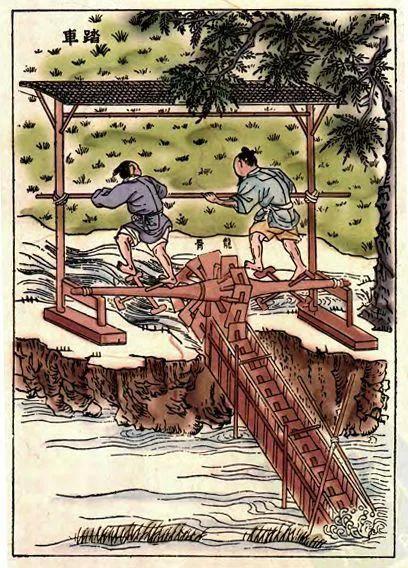
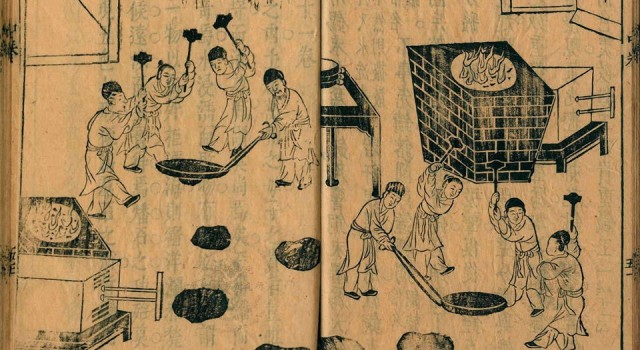
The book includes 123 hand-drawn illustrations, which are not only artworks but precise technical diagrams. For example, the diagram of the 'piston bellows' clearly shows how continuous airflow is generated through a linkage mechanism, representing one of the most advanced blowing technologies in the world at that time.
IV. Historical Impact
4.1 'Accidental Preservation' of Chinese Civilization
Ironically, 'The Exploitation of the Works of Nature' was almost lost in Qing Dynasty China. Due to certain content conflicting with the Qing official ideology (such as terms related to Manchu prohibitions) and the later Qing Dynasty's disregard for practical technology, the book disappeared in China for nearly two hundred years.
4.2 International Circulation and Return
- Japanese Influence: At the end of the 17th century, the book was introduced to Japan, directly promoting the Edo period's 'Studies of Exploitation,' and became an important tool for agricultural and mining improvements in Japan.
- Global Influence: In the 19th century, the book was translated into various European languages. Darwin's 'On the Origin of Species' quotes data from the 'Chinese Encyclopedia,' which is believed to refer to records of silkworm mutation from 'The Exploitation of the Works of Nature.'
- Cultural Return: At the beginning of the 20th century, Chinese scholars rediscovered this masterpiece through Japanese collections, causing a stir in academia.
V. Controversy and Limitations
5.1 Lack of Theoretical Paradigm
Despite Song Yingxing's remarkable observational skills, he failed to abstract observed phenomena into universal mathematical formulas like Newton or Galileo of the same period. He remained trapped in the Chinese traditional "Yin-Yang and Five Elements" explanatory framework. For example, when explaining gunpowder explosions, he tended to use non-quantitative descriptions such as "violent collision of Yin and Yang forces."
5.2 The 'Island Effect' of Technology
'The Exploitation of the Works of Nature' is more like a "settlement bill of civilization" rather than a starting point for innovation. In an empire that valued social order stability over technological efficiency, the precise technologies recorded by Song Yingxing often disappeared with craftsmen in the next dynasty change or turmoil, failing to form a cumulative scientific revolution.
VI. Conclusion
In 1644, the Ming Dynasty perished. As a Ming loyalist, Song Yingxing lived in seclusion in the mountains, refusing to serve the Qing Dynasty. The ingenious waterwheels, gunpowder, and weaving machines he recorded did not stop the iron cavalry of the nomadic civilization nor triggered an Eastern industrial revolution.
Song Yingxing's significance lies in his solo "empirical counterattack" within a civilization system that emphasized rational learning while neglecting physical sciences. Using data and drawings, he laid a solid anchor for the material civilization of the Ming Dynasty on the dark reefs of history. When evaluating Song Yingxing, it is important to see not how much he changed history, but how much truth about the hard power of civilization he preserved on the eve of a great historical collapse.