The name of a mountain
In the summer of 119 BCE, Mount Langjuxu in the heart of the Mongolian Plateau witnessed a solemn ceremony unlike any before. A Han cavalry force, still caked with the dust of campaign, used freshly captured Xiongnu livestock as offerings, built an altar on the enemy’s sacred snow-capped peak, and proclaimed to Heaven the might of the Great Han. The supreme commander of the Han army who stood at the front of that altar, looking out over the entire desert, was twenty-one years old that year.
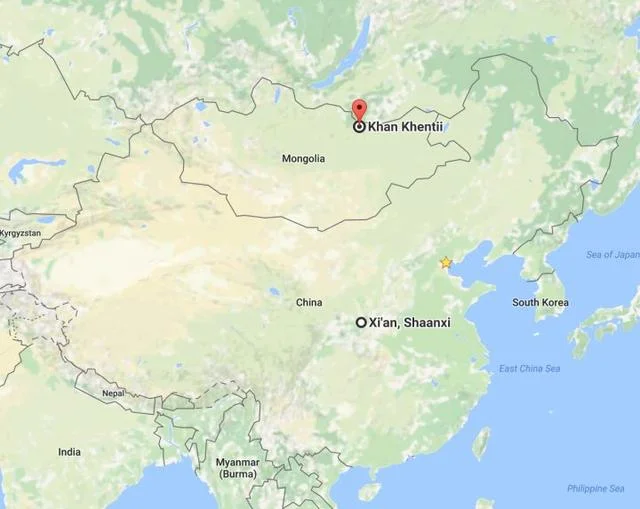
The mountain lies roughly in today’s Khentii range near Ulaanbaatar, capital of Mongolia—more than 1,500 kilometers in a straight line from Chang’an, capital of the Han Empire. In the second century BCE, without compass, without maps, and without any modern communications, to command fifty thousand picked cavalry, abandon baggage trains entirely, and cross the Gobi in search of a nomadic host that could vanish at will was, in the age of cold steel, almost a death sentence against every rule of war. Yet this twenty-one-year-old not only survived: deep in the desert he annihilated seventy thousand of the enemy’s main force, shattered the last dignity of the Xiongnu court, and fought all the way here.
From that day on, “feng langjuxu” was no longer just a place on the map; it was carved forever as the supreme martial ideal of Chinese soldiers across the ages. For more than two millennia afterward, whether Yue Fei, Xu Da, or countless iron-blooded generals who ate ice and slept in snow on the frontier, the ultimate dream of a lifetime was compressed into those four characters.
And the man who, in the history of human war, raised the ceiling for ancient Chinese generals in the most ruthless way—his name was Huo Qubing.
A humble start
Huo Qubing’s origins were never enviable in any era. His mother, Wei Shao’er, was a slave in Princess Pingyang’s household; his father, Huo Zhongru, was a minor clerk in Pingyang County. They had no formal marriage, and Huo Zhongru left after Wei Shao’er became pregnant—he later returned home, remarried, and had another son, Huo Guang, who would become one of the most powerful ministers of the Han Empire.
What changed Huo Qubing’s fate was his aunt Wei Zifu. Emperor Wu of Han (Liu Che) took her from singing girl to empress, and the whole Wei clan’s fortunes turned with her: Huo Qubing’s uncle Wei Qing rose from stable hand to Grand General of the Empire.
That background matters. Huo Qubing’s chance to command troops at seventeen was decisively tied to his status as imperial in-law. The emperor would not hand eight hundred picked cavalry to an unrelated youth. But it is equally important that in-law status only explains why he got onto the battlefield—not why he won. The Western Han had plenty of in-law generals; most of their names are forgotten.
Seventeen: the miracle of eight hundred cavalry
In 123 BCE, Wei Qing led a northern campaign against the Xiongnu. Huo Qubing went as “Colonel Piaoyao”—his first time on a battlefield.
The emperor gave him an unusual assignment: lead eight hundred cavalry, break away from the main army, and operate independently. That was itself abnormal—in the military system of the time, a seventeen-year-old with no combat experience receiving independent command had almost no precedent.
The result was staggering. Huo Qubing took those eight hundred deep into Xiongnu territory for hundreds of li, killed 2,028 men including senior officers such as the Xiongnu chancellor and danghu, and captured the Chanyu’s uncle Luogu Bi. Records of the Grand Historian: Biography of General Wei and Swift Cavalry General is extremely terse about this fight: Sima Qian gives almost only numbers, not the course of battle—which only deepens later puzzlement: how did a youth, with eight hundred men, deep in enemy country, do it?
After this campaign, Emperor Wu enfeoffed Huo Qubing as Marquis of Champion. “Champion” here means “foremost among the three armies”; the term later entered modern Chinese as the usual rendering of “champion.”
The Hexi campaigns: opening the door west
In 121 BCE, Huo Qubing was nineteen. That year he independently commanded two Hexi campaigns—the strategically most valuable operations of his career.
First Hexi campaign (spring): Huo Qubing led ten thousand cavalry from Longxi, fought for six days over more than a thousand li, crossed five Xiongnu tribal kingdoms, killed over 8,900 enemies, and captured the golden idol used in sacrifices to Heaven by King Xiutu of the Xiongnu. (Note: that idol was a key object in Xiongnu religious practice; the episode is often seen as an important moment of cultural contact before Buddhist images reached the Central Plains.) Second Hexi campaign (summer): he coordinated with Gongsun Ao in a pincer; Huo Qubing’s column again went deep alone, crossed Juyan Marsh (today’s Ejin Banner in Inner Mongolia), fought over two thousand li, killed or captured 30,200 Xiongnu, and took five kings, five queens, princes, chancellors, generals, and more than 120 others.
The direct outcome: King Hunye surrendered with more than forty thousand followers, and the Han Empire gained control of the Hexi Corridor. The emperor then established the four commanderies of Wuwei, Zhangye, Jiuquan, and Dunhuang—the famous “Hexi Four Commanderies.”
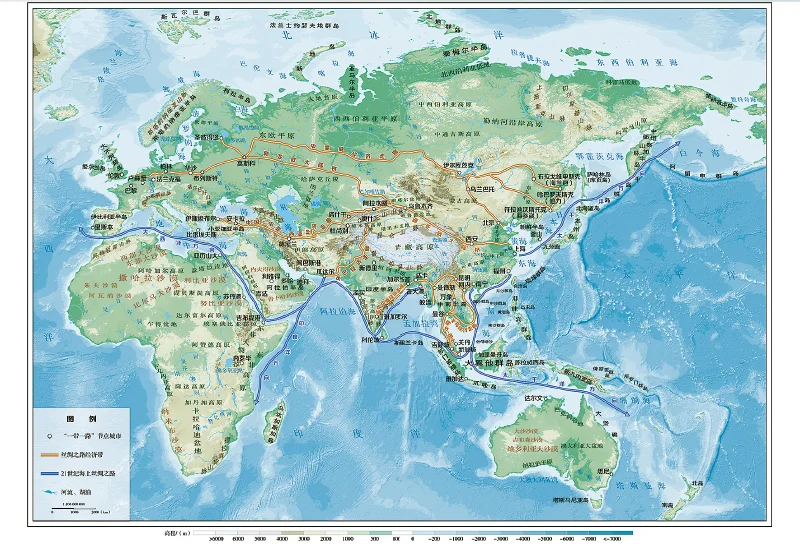
The corridor’s geographic importance cannot be overstated. It was the only overland link between the Central Plains and the Western Regions—the crucial chokepoint of what would become the Silk Road. Before Huo Qubing opened it, the Han Empire and Central Asia, West Asia, even the Mediterranean were separated by the whole Xiongnu empire. Opening the corridor meant stable overland contact between East and West for the first time.
On a world-historical timeline: in the same period, the Roman Republic had just destroyed Carthage, yet the bloody failure of the Gracchi reforms (also in 121 BCE) plunged it into long domestic turmoil. Rome and Han, the two superpowers at either end of Eurasia, both stood at a crossroads in the late second century BCE. While Romans searched the Mediterranean shore for a republican way out, a young Han general was cutting open Inner Asia with the sword. The line that would one day connect those two empires—the Silk Road—became real in large part because of Huo Qubing’s Hexi campaigns.
The northern desert campaign: feng langjuxu
In 119 BCE, Emperor Wu launched his largest offensive against the Xiongnu—the northern desert campaign. Wei Qing and Huo Qubing each led fifty thousand cavalry on separate thrusts deep into the desert north.
The environment was brutal: not only endless Gobi, but violent day–night temperature swings and desperately scarce water. Without maps or trail markers, supplying fifty thousand men and horses should have been an insoluble logistical nightmare. Against a nomadic army that could strike camp and vanish, Han forces were like hunters seeking a ghost ship on the ocean. Huo Qubing chose an extreme, all-or-nothing method: Records calls it “living off the enemy”— abandoning heavy baggage entirely, relying on stunning mobility to raid tribe after tribe, feeding his men on enemy herds.
Huo Qubing’s column set out from Dai Commandery (today’s Yu County, Hebei) and the Youbeiping area, marching north over two thousand li. The exact route is still debated among historians because Sima Qian’s account is sparse and the steppe left no fixed markers. The mainstream reconstruction is that his force crossed eastern Mongolia and finally, in the Khentii region of today’s northeastern Mongolia, pinned the main body of the Xiongnu Left Wise King.
The result was annihilation: 70,443 killed or captured; three kings including Tuntou and Han; and eighty-three senior Xiongnu officers—generals, chancellors, danghu, commandants. After the battle, the twenty-two-year-old Huo Qubing led his men up Mount Langjuxu for the Heaven sacrifice, then Mount Guyang for the Earth rite, then rode in pursuit until he halted only at Hanhai (the Lake Baikal region).
After the northern campaign, “the Xiongnu fled far away; south of the desert there was no royal court.” The Xiongnu political and military center was driven from southern Mongolia into colder lands farther north and, for decades afterward, could not mount another large-scale invasion of the Han Empire.
Lightning across time
Where did Huo Qubing’s military gift show? He was not a “famous general” in the traditional mold—he left no treatise, no systematic theory. Records says Emperor Wu once tried to teach him The Art of War and Wuzi; he refused, saying, “It depends on how you handle the actual situation; there’s no need to study the ancients’ methods.”
From his record, several traits stand out.
First, extreme mobility. Every campaign centered on long-range strikes—often a thousand li or two. Among Han commanders of the time he was unique: his uncle Wei Qing was also a great general, but Wei Qing’s style was steady advance and pitched battle. Huo Qubing’s idea—maximum mobility, deep raids, hitting vital points—has something in common, in spirit, with what later ages would call “blitzkrieg.”
Second, precise target selection. He always prioritized Xiongnu senior commanders and royalty. In the Xiongnu tribal confederation, princes and high officers held the tribes together—eliminating them yielded far more than killing the same number of common warriors.
Third, radical compression of logistics. His men lived off the campaign, taking supplies from the enemy. The risk was enormous, but success meant his columns were no longer chained to supply lines and could reach depths ordinary armies could not imagine.
For a cross-cultural parallel, the closest may be the Carthaginian Hannibal. In 218 BCE he crossed the Alps into Italy, also famous for long marches and minimal dependence on a rear base. Both showed extraordinary military intuition at a very young age. The difference: Hannibal ultimately lost to Rome’s ability to regenerate manpower and strategic depth; Huo Qubing’s foe, a nomadic empire, lacked that kind of slack that settled states enjoy.
Controversy and shadow
The real Huo Qubing was not all halo.
Records records a jarring incident: Li Guang’s son Li Gan, after his father got lost in the northern campaign, missed his rendezvous, and killed himself in shame, blamed Grand General Wei Qing and struck him in anger. When Huo Qubing learned of it, he shot Li Gan dead during a hunt with the emperor. Emperor Wu covered for Huo Qubing, announcing publicly that Li Gan had been gored by a deer antler.
The episode raises several issues. First, Huo Qubing had a violent, overbearing side—private violence to settle scores, with no legal consequence. Second, the emperor’s favor had reached the point of shielding a killer, which suggests Huo Qubing’s power was barely checked. Third, the feud between the Li and Wei–Huo clans reflected the complex power struggles at Emperor Wu’s court—military glory never happens in a vacuum.
Moreover, Sima Qian’s judgment of Huo Qubing in Records keeps a certain distance. He notes Huo Qubing was “quiet, not garrulous, daring and responsible,” but also “young, raised in the palace attendants, noble, and not considerate of common soldiers.” He adds a detail: the emperor once sent Huo Qubing several cartloads of food; “when he returned, the heavy carts still had leftover grain and meat, while some soldiers went hungry.” Sima Qian does not say the food had spoiled, but between the lines he suggests a measure of distance between Huo Qubing and his men.
These passages stand in stark tension with his dazzling victories. Whether he “loved his men like sons”—from the scattered evidence we cannot say for certain. What is clear is that his success rested less on deep bonds with the ranks than on personal genius and the emperor’s unconditional trust. That pattern is rare in Chinese military history—most celebrated generals are expected to “share hardship with the troops,” and Huo Qubing never seems to have needed that.
Twenty-four
In 117 BCE, Huo Qubing died. He was twenty-four.
The cause is unknown. Records uses only the word zu (“died”): “Three years after the fourth-year campaign, in the sixth year of Yuanshou, the Swift Cavalry General zu.” That was the standard term for an official’s death; Sima Qian gives no cause. The mystery has never been solved; later ages guessed illness, plague, damage from over-campaigning—but nothing firm. More than a century afterward, Ban Gu in Book of Han changed the word to hong—in Qin–Han usage, the term for the death of a king or high noble—raising the ceremonial rank of Huo Qubing’s end.
The emperor was shattered with grief. He ordered armored troops to line the road from Chang’an to Maoling and built for Huo Qubing a huge tomb shaped like the Qilian Mountains—a man-made mountain for the young man who had conquered real ranges. The tomb still stands today in Xingping City, Shaanxi Province; the “Horse Trampling the Xiongnu” stone in front is among China’s earliest large-scale stone sculptures.
Huo Qubing left a line later ages quote endlessly. When the emperor wanted to build him a lavish mansion, he answered: “How can I think of home while the Xiongnu are not yet destroyed?”
Whether he truly said it cannot be verified. That it has circulated for two thousand years is itself a historical fact. Every era has read into it what it needed—loyalty, sacrifice, a young man’s pure devotion to duty.
Coda: the measure of time
In world military history it is hard to find a second figure who achieved so much at so young an age. Alexander set out at twenty and died at thirty-three; in thirteen years he conquered from Greece toward India. Huo Qubing first fought at seventeen and died at twenty-four; in seven years he changed East Asia’s geopolitical map. The arcs are eerily alike: fame in youth, lightning conquest, early death.
Huo Qubing’s seven years were exactly seven—no more, no less. What he did in them—driving the Xiongnu from the Hexi Corridor, opening the overland Silk Road, pushing Han military reach toward Lake Baikal—echoed for centuries. The Hexi Four Commanderies remained, more than a millennium later in the Ming, a basic frame of China’s northwestern defense.
British historians Denis Twitchett and Michael Loewe, in The Cambridge History of China, Vol. 1: The Ch’in and Han Empires, writing of Emperor Wu’s wars against the Xiongnu, say Huo Qubing’s expeditions “fundamentally altered the balance of power between the nomadic peoples of Inner Asia and the sedentary civilizations.” That is accurate, but perhaps not enough: he did not only shift the balance—he changed how the two sides interacted. Before him, Han strategy toward the steppe was defense and marriage alliances; after him, taking the offensive became a real option.
Huo Qubing’s story is finally one of gift meeting age. Without Emperor Wu’s ambition and state capacity, his talent would have had nowhere to go; without his talent, the emperor’s ambition might have been only another costly failure (as it was for many Han generals of the same period). His sheer genius met the right moment, and lightning flashed—brief, yet illuminating the entire sky.