Modernization Paved with Cement and Steel Rails: China's Global Infrastructure Story
China's infrastructure aids Global South development. Taking the Mombasa-Nairobi Railway, Karakoram Highway, and Timor-Leste highway projects as examples, it drives local economies through technology transfer, job creation, and infrastructure connectivity, achieving mutual benefit and win-win outcomes.
Introduction: An East Timorese Minister's "Awe"
In 2017, in Timor-Leste, at a construction site in Suai, the country's third-largest city, a group of special visitors arrived.
The East Timorese Minister of Public Works led his entourage to visit a highway project under construction by a Chinese enterprise. When they stood before a massive bridge pier, the minister did something completely unexpected to everyone present—he called seven colleagues over, and it took eight people holding hands to encircle the pier. Then, they took a commemorative photo, and the minister said one sentence:
"The construction technology and capabilities of Chinese enterprises leave us in awe."
This story was reported by multiple international media outlets and became a microcosm of China's infrastructure construction in the "Global South." Timor-Leste, a country that only gained independence in 2002, had many citizens who didn't even know what a highway was before. Now, they have their first highway—155 kilometers long, designed for speeds of 80 to 100 km/h, and the largest infrastructure project in Timor-Leste's history.
This is not an isolated story. From the Mombasa-Nairobi Railway on the East African savannah to the Karakoram Highway in the China-Pakistan Economic Corridor; from the E763 highway in the Balkan Peninsula to the cross-sea bridges in Southeast Asia—China is participating in reshaping the development landscape of the "Global South" in a unique way.
From the "Steam Age" to the "High-Speed Rail Age": Kenya's Story with the Mombasa-Nairobi Railway
A Railway that Changes Destiny
On May 31, 2017, at Mombasa Port, Kenya, a train slowly departed the station platform.
This was the Mombasa-Nairobi Railway—the first modern railway built since Kenya's independence, spanning approximately 480 kilometers and connecting Kenya's largest port, Mombasa, with the capital, Nairobi. Before this, Kenyans were still using the meter-gauge railway built by the British in 1901—a railway even older than China's green-skinned trains.
The data after its opening was astounding:
- Average occupancy rate exceeds 90%
- Created over 74,000 jobs for Kenya
- Trained over 2,800 high-quality railway technical and management professionals
- Contributed over 2% to Kenya's Gross Domestic Product
This is not an ordinary railway. It is a modern railway built using Chinese standards, technology, and equipment. From design and construction to operation and maintenance, it is fully "Made in China." But more importantly, it genuinely changed the fate of Kenyans.
Railway Talent Cultivation Starting from "Zero"
Among the operational team of the Mombasa-Nairobi Railway, there was a young Kenyan named Pat. Initially, he knew nothing about railways. His Chinese mentors—Wang Yang, Cai Shichao, Lei Yong—taught him step by step, starting with the most basic component names.
Instructor driver Lei Yong was in his 50s and was affectionately called "Brother Lei" by everyone. To help Pat learn driving skills, Brother Lei used video explanations, graphic translations to overcome language barriers, and patiently instructed. In less than a year, Pat passed the assistant driver exam and could sit alone in the driver's seat alongside Chinese drivers, speeding along the railway line.
Pat later became a certified locomotive driver. When he first independently drove the train, a proud smile appeared on his face. But he likely didn't know how much effort his three Chinese mentors had put into teaching him these skills—overcoming the different climate conditions in Kenya compared to China, overcoming language communication barriers, starting work under a sky full of stars at night.
The Ordinary People Whose Lives Were Changed
The Mombasa-Nairobi Railway changed more than just Pat.
Locomotive driver Conilia Wire is a female driver on the Mombasa-Nairobi Railway. In Kenya, traditional views hold that locomotive driving is a man's profession. But under the guidance of Chinese mentors, she broke this prejudice. "My Chinese mentor taught me a lot of knowledge," she said, "I never regret choosing this career."
Titus Kiprono, deputy director of the Nairobi Electromechanical Maintenance Workshop, said: "I have been very happy during my time at Star of Africa (operating company), especially grateful to my Chinese mentors for allowing me to learn professional knowledge and get promoted."
According to statistics, the Mombasa-Nairobi Railway provided Kenyans with employment opportunities covering 5 major specialties and 123 job types, cumulatively recruiting over 3,000 local employees. More importantly, these Kenyans started from "zero" and learned a complete set of modern railway operation technologies.
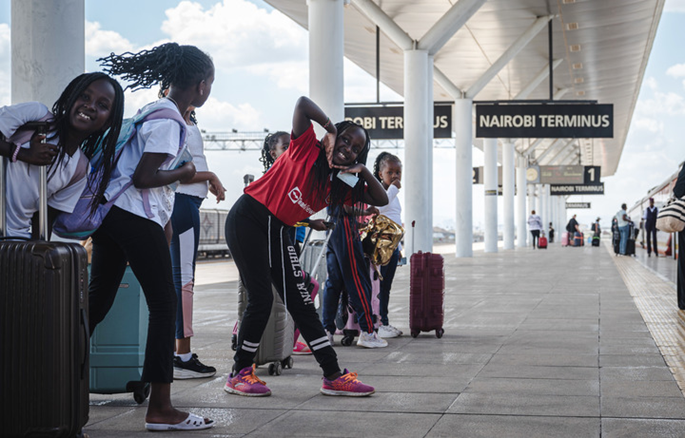
A Kenyan girl said in an interview: "The Mombasa-Nairobi Railway not only brings material circulation but also awakens our national pride."
Crossing the Roof of the World: The Karakoram Highway of the China-Pakistan Economic Corridor
A Sixty-Year Friendship Road
In Pakistan, there is a road locally called the "China-Pakistan Friendship Highway."
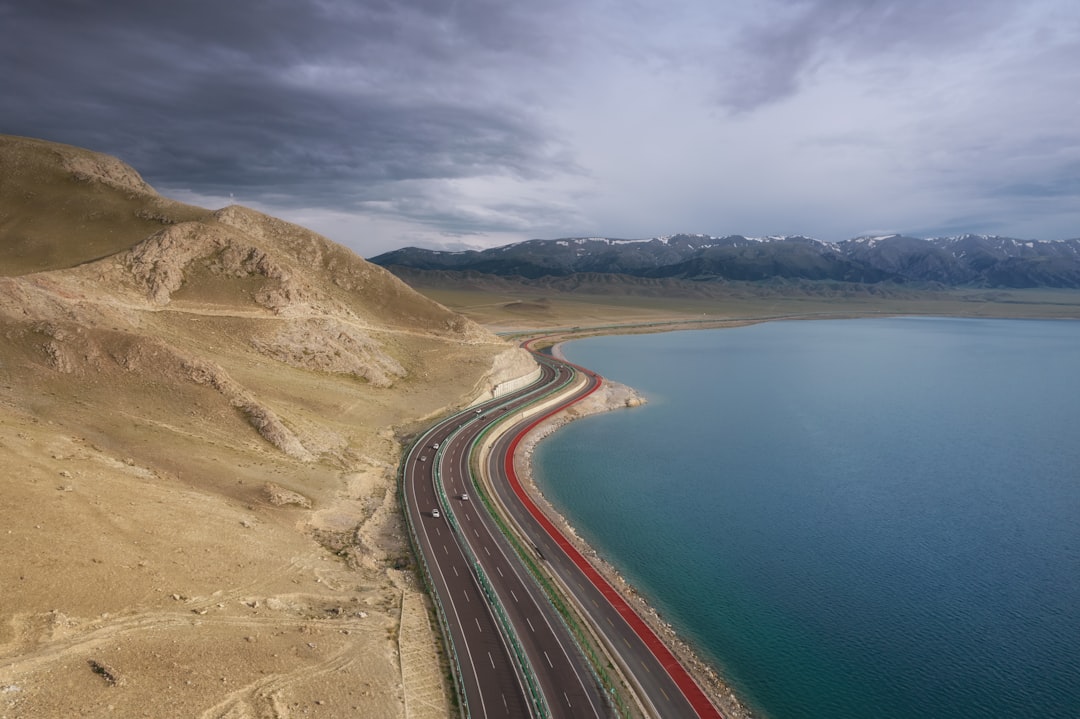
This is the Karakoram Highway. It starts from Kashgar in Xinjiang, China, in the north, and reaches Gwadar Port, Pakistan, in the south, spanning 3,000 kilometers and serving as the main artery of the China-Pakistan Economic Corridor. This highway crosses the Karakoram Mountains, the Himalayas, and the Hindu Kush, passing through the Pamir Plateau, known as the "Roof of the World."
This is not a newly built road. Its predecessor was initially constructed in 1968, jointly built by China and Pakistan, taking 11 years to be fully completed. At that time, Chinese builders made tremendous sacrifices—hundreds of Chinese engineering personnel are buried in Pakistani soil.
In 2015, the construction of the China-Pakistan Economic Corridor officially commenced. The upgrade and renovation of the Karakoram Highway became a key project. The second phase extends from Havellian to Thakot, spanning 487 kilometers, including 118 kilometers of expressway and 369 kilometers of ordinary highway.
The Story of Truck Driver Israr
In Pakistan, there is a truck driver named Israr. The second phase of the Karakoram Highway is the route he most frequently travels.
"This road carries people's beautiful expectations for life," Israr said, "It is a safe road and also a road to prosperity."
In the past, driving from Havelian to Thakot took nearly 6 hours. The road was narrow and treacherous, winding through high mountains, with frequent accidents. Many drivers turned pale at the mention of this road.
Now, on the 118-kilometer expressway, 105 mainline bridges, 11 overpasses, 464 culverts, and 6 tunnels have been built. The road is wide and gentle, reducing one-way driving time to less than 2 hours.
Israr said: "Driving this road used to be risking your life; now it's completely different."
Transformation in the Land of Mangoes
In Multan, Pakistan, this is a place famous for mangoes.
With the official opening of the Sukkur-Multan section of the Peshawar-Karachi Motorway, the central north-south transportation artery of Pakistan was connected. The time to transport the new season's mangoes from orchards to markets was reduced from 11 hours to about 4 hours. Damage to agricultural products from bumpy transport was significantly reduced.
For fruit farmers, this means a direct increase in income. One fruit farmer said: "It used to take a whole day to get mangoes to the market, with a lot of damage from the bumpy journey. Now the time is shorter, damage is less, and our income has increased significantly."
What makes fruit farmers even more expectant is that a juice concentrate factory is being planned. With convenient transportation, deep processing of mangoes has also become possible.
Gwadar Port: From Fishing Village to International Port
At the southern end of the China-Pakistan Economic Corridor, Gwadar Port is writing a new story.
This deep-water port on the coast of the Arabian Sea was once just a remote fishing village. Now, it has been built into a multi-purpose terminal with three 50,000-ton berths, possessing full operational capabilities.
Since 2024, Gwadar Port has achieved several "firsts": systematically conducting transit business for Afghan goods for the first time, conducting liquefied petroleum gas business for the first time, and achieving commercial operation for the first time. The first phase of the free zone construction has been completed, with 35 enterprises settled and investment exceeding 3 billion yuan.
A local businessman said: "Gwadar Port is becoming the Shenzhen of Pakistan."
Data shows that as of the end of 2022, the China-Pakistan Economic Corridor has cumulatively brought $25.4 billion in direct investment to Pakistan, created 236,000 jobs, helped Pakistan add 510 kilometers of expressways, 8,000 megawatts of electricity, and 886 kilometers of national core power transmission grid.
Timor-Leste: From Never Seeing a Highway to Having Its First One
The Aspiration of a Newborn Nation
In 2002, Timor-Leste formally gained independence, making it one of the youngest countries in Asia.
After independence, Timor-Leste faced huge development challenges. This country with a population of only 1.3 million has a narrow, elongated territory and almost zero infrastructure. Many East Timorese had not only never traveled on a highway, but many had never even seen one.
In 2015, an opportunity came to change Timor-Leste's destiny. A consortium of China Railway International and China Railway First Group won the bid for the Suai Highway project. This was the first highway in Timor-Leste's history and the largest transportation infrastructure construction project since the country's independence.
The project spans 155 kilometers, designed for speeds of 80 to 100 km/h. Starting from Suai, it connects strategic projects like the southern oil city. For Timor-Leste, this road is the path to modernization.
The Minister and the Bridge Pier Story
When the East Timorese Minister of Public Works visited the construction site, he was awed by the massive bridge piers. It took eight people holding hands to encircle one pier—this scale and difficulty of engineering was something East Timorese had never imagined.
"In the past, many East Timorese didn't know what a highway was," the minister said, "But now, we have a highway as good as those in Malaysia and Singapore. I am very proud!"
This is not an exaggeration. Before the construction of this highway, Timor-Leste's transportation conditions were extremely backward. Many roads were bumpy and uneven, becoming muddy and difficult to traverse during the rainy season. Traveling from one village to another often took hours or even a whole day.
The completion of the Suai Highway has completely changed Timor-Leste's transportation landscape and also provided infrastructure support for the country's integration into regional economic integration.
Abraham's Growth
On the Suai Highway project, there is a local surveyor named Abraham.
Over more than two years of joining the project, he grew from a layman into a technical professional with specialized skills. Appearing at the construction site every day wearing a yellow hard hat, he not only learned to use various surveying instruments but also mastered basic knowledge of engineering management.
"My Chinese colleagues respect and appreciate my professionalism and efforts at work," Abraham said, "This makes me feel my work is valuable. I thank my Chinese 'mentors' for everything they taught me."
Since the project commenced, the consortium has actively fulfilled social responsibilities, helping local villages build roads and bridges, level land, construct water supply pipelines and sewage treatment pools for local hospitals and churches, and provide internship opportunities for university students. In early 2018, when a local fire broke out, the consortium quickly dispatched water trucks and other equipment to help extinguish the blaze. Timor-Leste's mainstream media, the Timor Post, published a special report on this, praising the Chinese company's performance.
A Chinese engineer involved in the project construction said: "We are not only building a road, but also building a bridge of friendship between China and Timor-Leste."
Balkan Breakthrough: Chinese Infrastructure Enters Europe
Serbia's 25-Year Dream
Although Serbia is located in Europe and does not belong to the traditional 'Global South' countries, as a developing country, its cooperation case with China is equally representative and worthy of reference.
On July 5, 2025, the Preljina-Požega section of Serbia's E763 Highway opened to traffic.
This is the first infrastructure project implemented under the China-Central and Eastern Europe cooperation framework, and also the first highway constructed by a Chinese enterprise in Europe. Serbian President Aleksandar Vučić delivered a speech at the opening ceremony, highly praising the outstanding contributions of Chinese builders.
"Without the diligent work of Chinese builders, none of this would have been achieved," said a local resident.
The E763 Highway is approximately 300 kilometers long, serving as a major transportation artery connecting the Balkan region with surrounding countries. It links Serbia's capital, Belgrade, with Montenegro's seaport, providing this landlocked country with convenient access to the Mediterranean Sea.
Located in the Central European Balkan Peninsula, Serbia has long suffered from lagging infrastructure development due to complex terrain and a lack of funds. Since its independence, Serbia had planned to build this highway but had been unable to realize it.
"We waited 25 years," Vučić said, "China helped us realize this dream."
Teaching a Man to Fish: Technology Transfer
What China did in Serbia was not just build a road.
During the construction of the E763 Highway, the Chinese engineering team employed over 30 Serbian local enterprises to participate, with up to 1,000 Serbian workers and technicians involved in the project at peak times. More importantly, Chinese engineers worked alongside Serbian engineers, teaching techniques hand-in-hand.
"China not only helped Serbia complete the highway construction," Vučić said, "but also provided Serbia with advanced highway construction technology free of charge."
This "teaching a man to fish" approach stands in stark contrast to traditional Western aid models. Western aid often comes attached with various political conditions, or provides only funds while neglecting technology transfer. China's approach is: not only help you get the road but also teach you how to build roads.
A Door Opener to the European Market
The success of the E763 Highway earned Chinese infrastructure a good reputation in Europe.
After its opening, more and more European countries began proactively contacting China, seeking infrastructure construction cooperation. Other countries in the Balkan region—Bosnia and Herzegovina, Montenegro, North Macedonia—have all expressed hopes for China to participate in their highway and railway construction.
An analyst from a European think tank commented: "China's success in Serbia demonstrates the strength and capabilities of Chinese infrastructure enterprises. Europe's infrastructure is aging, with a huge gap; Chinese enterprises have significant development space here."
The Dilemma of the Western Model: The Paradox of Aid and Control
The Dilemma of Attached Conditions
For a long time, Western aid to developing countries has often been attached to various political conditions. Structural adjustment programs require recipient countries to cut government spending, privatize state-owned enterprises, open markets—these measures often exacerbate poverty and social instability in developing countries.
World Bank loans typically require recipient countries to accept policy recommendations aligned with the "Washington Consensus." These policies have caused negative consequences in many countries in Latin America, Africa, and Asia—industrial hollowing out, widening wealth gaps, lack of social security.
In contrast, China's infrastructure construction cooperation adheres to the principle of "extensive consultation, joint contribution, and shared benefits." It does not attach political conditions, does not interfere in internal affairs, and respects the recipient country's sovereignty and choice of development path.
Efficiency and Sustainability
Western aid projects also have a common problem: low efficiency and poor sustainability.
Many infrastructure projects aided by the West fall into disrepair and gradually become dilapidated after the aid period ends. The reason is that these projects are often contracted to Western companies for construction, with limited technology transfer; local areas lack maintenance capabilities; and project design may not align with local actual needs.
China's infrastructure construction projects emphasize "teaching a man to fish." From design and construction to operation and maintenance, Chinese enterprises participate throughout, while extensively training local employees to ensure projects can continue operating after handover.
The Mombasa-Nairobi Railway is a typical case. During project construction, many Kenyan employees were trained. During the operation phase, a "master-apprentice system" was implemented, with Chinese mentors teaching Kenyans various techniques hand-in-hand. By 2024, the Mombasa-Nairobi Railway had been operating safely for over 2,500 days, cumulatively transporting over 30 million tons of cargo and sending over 12 million passengers.
The Relationship Between Infrastructure and Development
A fundamental problem with Western development aid lies in: they often overlook the foundational role of infrastructure in development.
Research in development economics indicates that infrastructure is a fundamental condition for economic development. Without roads, agricultural products cannot be transported out of rural areas, and industrial goods cannot enter rural markets; without ports, a country cannot integrate into the global trade network; without electricity, industry and services cannot develop.
China's infrastructure construction in the "Global South" precisely seizes this key point. By improving connectivity, China helps many developing countries break through development bottlenecks.
"When roads connect, all industries prosper"—this Chinese saying is being verified on the lands of the "Global South."
The Story Behind the Data: Numbers that Change Destiny
Let's look at a set of data:
Mombasa-Nairobi Railway (Kenya)
- Jobs created: 74,000
- Talent trained: over 2,800
- GDP contribution rate: over 2%
- Operation time: over 2,500 days of safe operation
China-Pakistan Economic Corridor (Pakistan)
- Cumulative investment: $25.4 billion
- Jobs created: 236,000
- New expressways added: 510 kilometers
- New electricity added: 8,000 megawatts
Suai Highway (Timor-Leste)
- Construction length: 155 kilometers
- Design speed: 80-100 km/h
- Project nature: Largest infrastructure project in Timor-Leste's history
E763 Highway (Serbia)
- Construction length: approximately 300 kilometers
- Participating enterprises: Over 30 local enterprises
- Technology transfer: Provided highway construction technology free of charge
Behind these numbers are the changed destinies of countless ordinary people: Pat growing from a railway layman to a locomotive driver; Israr moving from driving on dangerous cliff roads to safe expressways; Abraham transforming from a novice surveyor into a technical professional; East Timorese seeing a real modern highway for the first time.
Parable: A Story of a Bridge
Imagine a village split in half by a large river. The villagers want to build a bridge but lack sufficient funds and technical expertise.
A wealthy man says: "I can lend you money to build the bridge, but you must manage the village according to my way."
Another person says: "I will not only lend you money to build the bridge but also send engineers to teach you the technology of building bridges. In the future, however many bridges your village wants to build, you can build them yourselves."
Whom would the villagers choose?
This parable may be overly simplified, but it illustrates a truth: true help is not making the recipient dependent on the helper, but enabling the recipient to acquire the capacity for self-development.
China's infrastructure construction in the "Global South" is precisely this practice of "teaching a man to fish." It is not about control, not about dependency, but about cooperation and mutual benefit.
This, perhaps, is the most concrete practice of a "Community with a Shared Future for Mankind."